
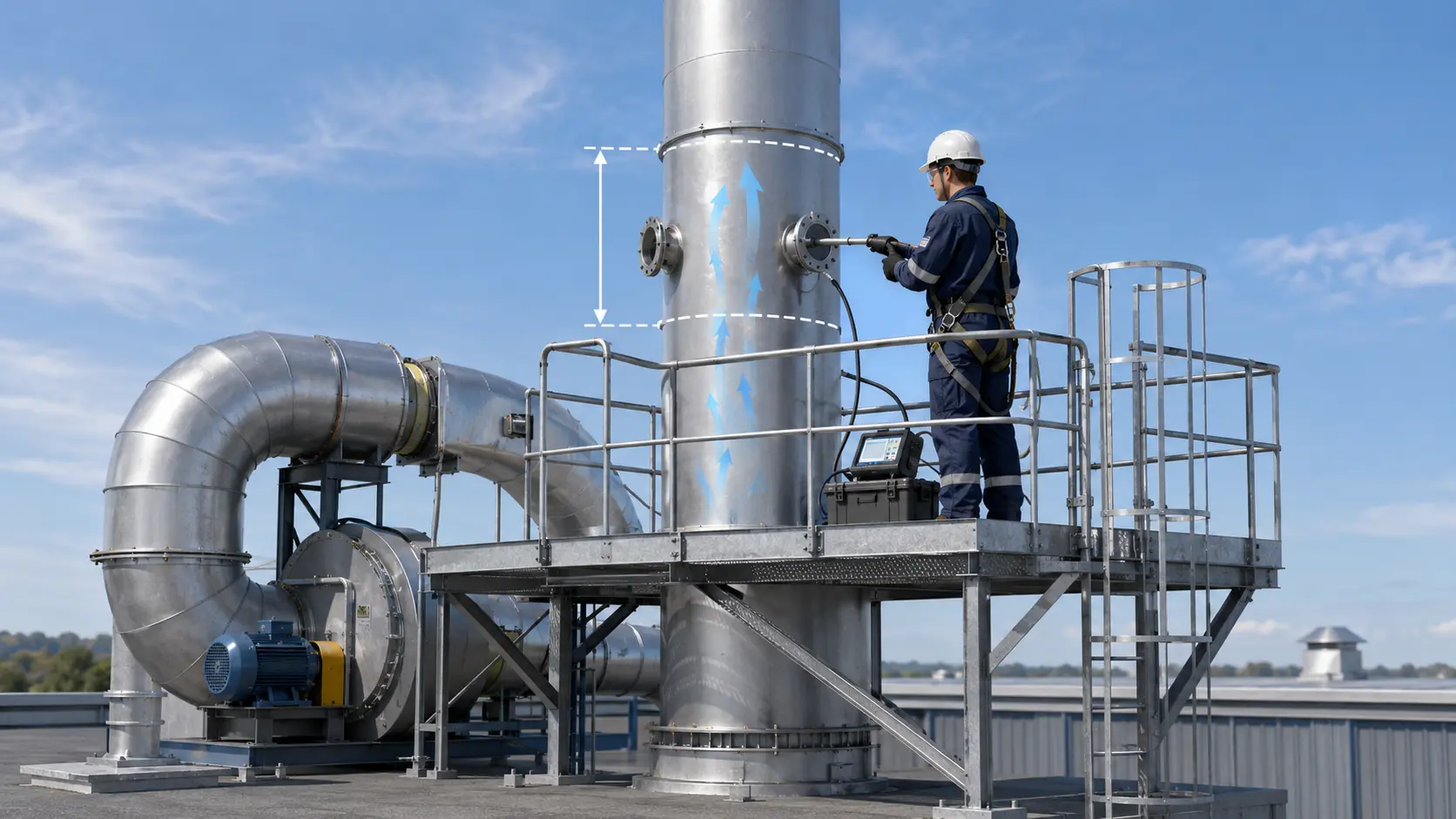
Why the measurement location determines usability of measurement
Authorised emission measurement is not only a question of instrument and laboratory. For the result to be usable for the authority, operating permit or operating records, a representative sample of waste air must be possible to take.
That depends mainly on where the measurement location is placed, how air flows in the duct, whether measurement ports are available, whether safe access is ensured and whether measurement can be carried out under appropriate operating regime.
An unsuitable measurement location may cause measurement to be technically difficult, time-consuming, less representative or, in extreme cases, impossible.
Operators often address the measurement location only when the measurement team arrives. That is too late. For new technologies, filter replacements, exhaust modifications and HVAC projects it is advisable to verify the measurement location already in design.
Who this topic concerns
The measurement location on the exhaust should be addressed especially by operators and designers of these installations:
- paint shops and drying technology,
- boiler plants and combustion sources,
- technological exhausts from production,
- particulate pollutant filters,
- extraction from welding shops, grinders and wood-processing operations,
- exhausts from chemical and surface treatment,
- recycling, crushing and sorting technology,
- separators, gas scrubbers and afterburner units,
- ventilation systems discharging polluted air to outdoor air.
It is important to distinguish routine service opening, inspection opening and actual measurement location for emission measurement. The fact that the duct can be looked into somewhere does not yet mean the location is suitable for sampling and flow velocity measurement.
Most common mistakes at the measurement location
Most problems arise with exhausts designed without regard to future emission measurement. Typically this involves ductwork with bends, dampers, fans or cross-section changes close to the sampling point.
| Mistake | Practical impact |
|---|---|
| missing measurement port | measurement cannot be carried out without intervention in ductwork |
| short straight duct section | flow may not be steady and representative |
| measurement location behind bend, fan or damper | turbulence and uneven flow arise |
| measurement location close to discharge to air | sampling and velocity measurement may be problematic |
| unsuitable diameter or duct shape | harder to determine measurement cross-section |
| poorly placed ports | probe cannot be inserted to required position |
| insufficient space around duct | measurement equipment cannot be used safely |
| missing platform or safe access | measurement cannot be carried out safely |
| hot, humid or fouling exhaust without preparation | higher risk of technical problems during measurement |
| unclear exhaust marking | problem with link to permit and report |
These mistakes are not merely formal. They can affect whether the measurement result is defensible and whether the report can be used as documentation for fulfilling the obligation.
Straight duct sections and turbulence
One of the most common problems is unsuitable placement of the measurement location relative to bends, fans, dampers, branches, silencers, cross-section changes or other elements that disturb flow.
For emission measurement it is desirable that flow in the measurement cross-section is as steady as possible. If the measurement location is placed close behind a bend or fan, velocities and concentrations in the cross-section may be uneven. The result may then poorly represent actual source emissions.
When designing the exhaust it is therefore advisable to:
- leave sufficient straight section before the measurement location,
- leave sufficient straight section after the measurement location,
- avoid placing the port close behind fan, damper, bend or reducer,
- not place the measurement location in an area with swirling or pulsating flow,
- address the measurement location before manufacture or duct installation.
Exact assessment depends on duct geometry, type of measurement, method used and specific technology. It is therefore advisable to send a duct schematic or photographs in advance.
Measurement ports and access to ductwork
A measurement port must allow safe insertion of the measurement probe into the duct. A small opening or service plug is not enough. Depending on type of measurement, several sampling points or possibility to measure at different positions in the cross-section may be needed.
In practice the following should be addressed in particular:
- diameter and length of measurement port,
- orientation of port relative to duct,
- number of ports according to duct shape and size,
- possibility of inserting probe to required depth,
- port sealing after measurement,
- thermal resistance and mechanical stability,
- space for operator and measurement equipment.
For large ducts, rectangular ducts or exhausts with uneven flow it may be necessary to address several measurement planes or several sampling points. For small ducts the problem may be the opposite: there is nowhere to place the port safely while maintaining suitable flow.
Work safety during measurement
The measurement team must have safe access to the exhaust. If the measurement location is at height, on the roof, at hot ductwork or in a space with limited access, safety must be addressed in advance.
Problems arise especially with:
- measurement from ladder without working platform,
- narrow space between duct and structure,
- missing guardrails,
- slippery or non-load-bearing roof,
- hot surfaces,
- ductwork above technological equipment,
- impossibility of safely handling the probe,
- unavailable electrical power,
- risk of falling objects or persons.
Safe access is not an administrative detail. If measurement cannot be carried out safely, it may not be possible at all. For new exhausts we therefore recommend designing the measurement location including working platform, access, lighting and space for equipment.
When to address the measurement location in advance
We recommend verifying the measurement location whenever emission measurement is being prepared for the first time or when the exhaust has changed technically.
It is advisable to be alert especially in these situations:
- new source or new exhaust,
- replacement of filter, separator or afterburner unit,
- change of duct route,
- relocation of fan,
- addition of damper, silencer or mixing chamber,
- change of diameter or duct shape,
- roof reconstruction or access to stack,
- older exhaust where measurement has not yet been carried out,
- authority request for new emission measurement,
- preparation of operating permit amendment.
If the measurement location is verified only on the day of measurement, it may be too late. Unnecessary site visit, impossibility of measurement or need for additional modifications usually cost more time than preliminary assessment from photographs and schematic.
What to prepare before assessment of the measurement location
For quick assessment simple documentation usually helps. Complex documentation is not needed immediately, but the better the exhaust is described, the more accurate the conclusion.
Send us in particular:
- photographs of the exhaust from greater distance,
- detailed photographs of ductwork and existing openings,
- duct route schematic,
- duct diameter or dimensions,
- distance of measurement location from bends, fans, dampers and branches,
- height of measurement location above floor or roof,
- information on access to the location,
- operating permit or authority request,
- last emission measurement report if any,
- description of technology and filtration.
For a new exhaust it is ideal to address the measurement location already in project documentation. For an existing exhaust, photographs, basic dimensions and a brief description are often enough to determine whether the location is usable or modification will be needed.
Practical recommendation for designers
HVAC and technological exhaust designers should treat the measurement location as a routine part of design. For sources that will be subject to emission measurement it is advisable to design the exhaust so that it is measurable, accessible and safe.
When designing we recommend verifying:
- whether the source will be subject to one-off or continuous emission measurement,
- which substances will probably be measured,
- where a suitable measurement section will be,
- whether straight duct sections will be available,
- whether measurement ports can be installed,
- whether safe access to the location will be possible,
- whether there will be enough space for probe handling,
- whether the measurement location corresponds to technology operating regime.
Subsequent addition of a port to completed ductwork is possible, but does not always solve the problem. If the port is placed in a hydraulically unsuitable location, the opening alone is not enough.
What you can send us for assessment
If you are unsure whether the exhaust is suitable for emission measurement, send us photographs, duct schematic, exhaust dimensions, measurement location height, access description and information on which technology is connected to the exhaust.
We will verify whether the location is probably usable for measurement, what modifications may be needed and whether it is advisable to add measurement ports, working platform or other access. For new technologies we can assess the measurement location before manufacture or exhaust installation.
Summary
The measurement location on the exhaust is key for usability of emission measurement. Most common problems are missing ports, short straight sections, turbulence, unsuitable placement behind bend or fan, poor access and unsatisfactory safety conditions.
The operator should address the measurement location in advance, especially for new exhausts, filtration replacements, HVAC modifications and first measurements at a source. The designer should include exhaust measurability in design from the start. Timely assessment can prevent unnecessary site visit, additional modifications and problems with recognition of measurement results.
Factual basis of the article
The article is based mainly on requirements for emission measurement from stationary sources, general requirements for representative sampling and technical rules for measurement sections and measurement stations.
| Source | Practical significance |
|---|---|
| ČSN EN 15259 – Air quality, measurement of emissions from stationary sources | sets requirements for measurement sections, measurement stations, measurement objective, measurement plan and measurement report |
| MoE – industry and energy in air protection | contains methodological information, designated technical standards and reporting obligations in the air field |
| Act No. 201/2012 Coll., on air protection | sets basic obligations of operators of stationary air pollution sources |
| Decree No. 415/2012 Coll. | regulates details on permissible pollution levels and emission determination |
| Emission measurement – NATURCHEM | authorised emission measurement service and technical assessment of measurement conditions |
From a practical point of view these sources imply that emission measurement should be carried out so that the result best corresponds to actual source operation. Access to the exhaust alone is not enough. A suitable measurement section, suitable sampling points, safe measurement station, known operating regime and documentation enabling correct preparation of measurement plan and report are necessary.
For new or modified exhausts we recommend addressing the measurement location already in the design phase. For existing exhausts it is advisable before ordering measurement to verify at least photographs, duct dimensions, access and distances from elements that may disturb flow.