
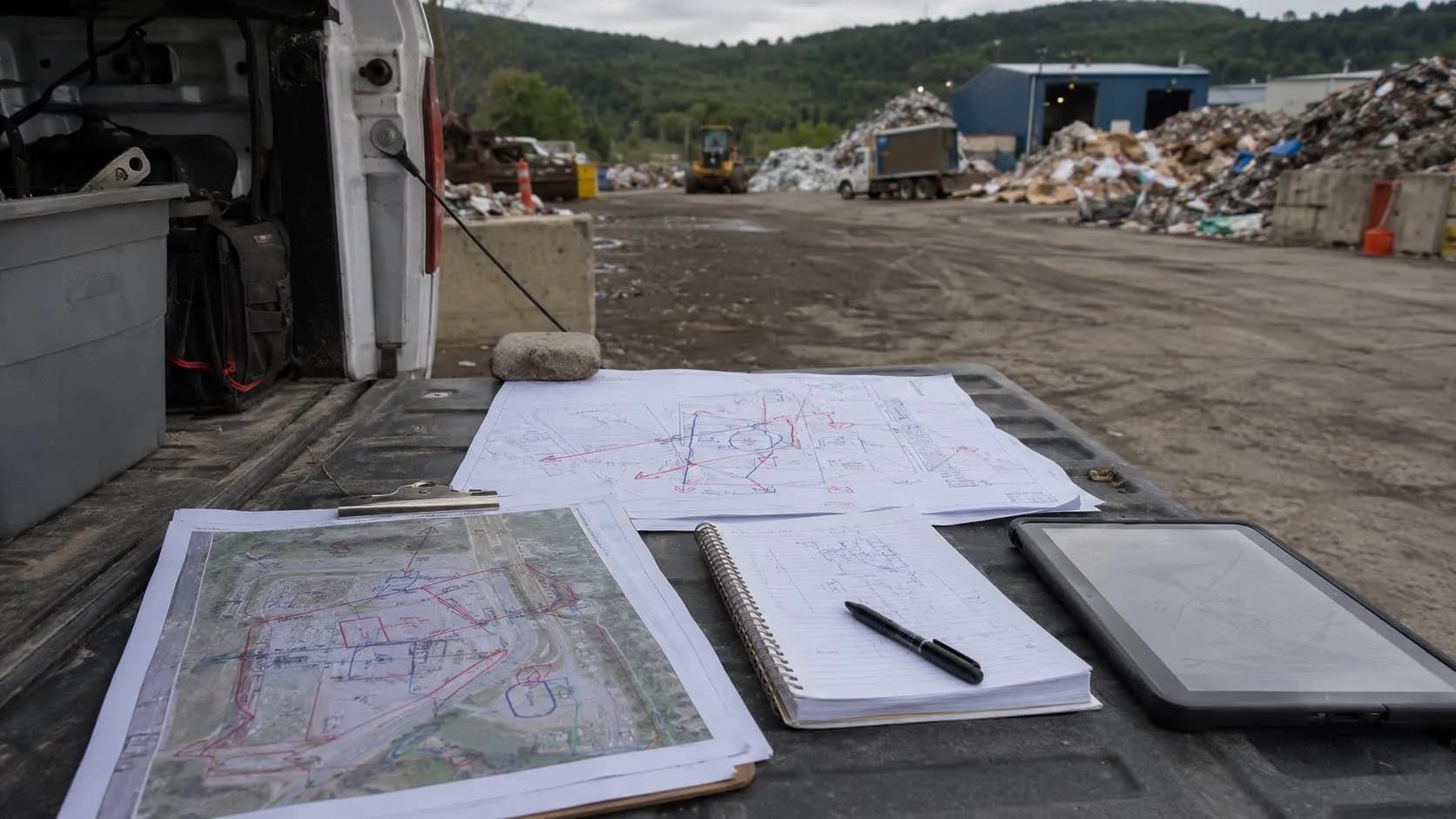
Why the difference between emissions and immissions matters
In practice, "emission measurement" and "immission impact" are often confused. An operator may feel that if technology meets the emission limit at the exhaust, everything is resolved from an air-quality perspective. It is not that simple.
Emissions are pollutants released from a source into the air. Typically this means concentration or mass flow from a stack, exhaust, filter, boiler, paint shop, welding shop, crusher, diesel generator set, or other technology.
Immissions are pollutant concentrations in surrounding outdoor air — not what leaves the source, but what appears at a given location after atmospheric dispersion.
Emissions are assessed at the source. Immissions are assessed in the territory. An operator can therefore meet an emission limit and still need to demonstrate that the project does not unacceptably worsen the immission situation.
This distinction is essential when permitting boilers, paint shops, recycling centres, landfills, composting facilities, backup diesel generators, welding shops, wood-processing plants, or projects with significant traffic.
Emissions from the source
Emissions describe the quantity of pollutants released from a source. For stationary sources, emission concentration, mass flow, annual emissions, and compliance with emission limits are most commonly assessed.
Different operations track different substances. For a gas boiler these may be mainly NOx and CO. For a paint shop, VOC or TOC. For wood processing, TSP. For a diesel generator, NOx, CO, and TSP. For welding, particulate matter and, depending on circumstances, metals.
| Source type | Typical emissions |
|---|---|
| boiler plant | NOx, CO, possibly TSP and SO2 depending on fuel |
| paint shop | VOC, TOC, TSP from overspray |
| welding shop | TSP, welding fumes, possibly metals |
| wood-processing plant | wood dust, TSP |
| recycling line | dust, TSP from crushing, sorting, and handling |
| diesel generator | NOx, CO, TSP |
| composting facility or landfill | odorous substances, dust, landfill gas depending on operation type |
Emission measurement answers whether a source releases pollutants within the permitted quantity or concentration. It may be carried out on a stack or exhaust; for some sources emissions are determined by calculation — for example from fuel quantity, operating hours, solvent consumption, or emission factors.
Immissions in the surroundings
Immissions express the resulting pollutant concentration in air at a specific location. It depends not only on how much substance the source releases, but also on how it disperses in the atmosphere.
Immission conditions are influenced by stack height, temperature and velocity of discharged air, surrounding terrain, built environment, meteorological conditions, wind direction and speed, distance to residential development, and the current pollution level in the area.
In practical terms: the same source may have negligible impact in one location and be problematic in another. Not only the source itself matters, but also where it is located.
| What influences immissions | Practical significance |
|---|---|
| stack height | a higher stack usually improves dispersion |
| flue-gas velocity and temperature | affects exit momentum and buoyancy |
| surrounding buildings | can worsen flow and cause local accumulation |
| relief | valleys and enclosed spaces can worsen dispersion |
| meteorology | a wind rose is a key input for modelling |
| proximity of residential buildings | determines sensitivity of the assessed locality |
| background pollution | shows how burdened the area already is |
For many projects, a dispersion study is therefore prepared. It does not assess emissions alone, but their conversion to immission concentrations in the surroundings.
Dispersion model
A dispersion model is a professional calculation that converts source emissions into concentrations in surrounding air. It uses technical data on the source, emission parameters, operating time, exhaust location, meteorological data, and map bases.
A dispersion model answers: what contribution will the source make at specific locations nearby?
It is therefore not only about how much substance the source releases. Where pollution spreads and what concentration may arise at the nearest residential development, in an area with worse immission conditions, or where immission limit compliance is assessed, also matters.
A dispersion study typically includes:
- emission concentration or mass flow,
- operating hours,
- exhaust height and diameter,
- flow rate, temperature, and air velocity,
- source position in coordinates,
- wind rose,
- surrounding terrain and buildings,
- immission background,
- location of reference points nearby.
For area and fugitive sources — for example recycling sites, landfills, storage areas, or roads — modelling is more complex. It is not just a stack, but material handling, vehicle movements, transfers, storage, or secondary dust.
Immission limits
Immission limits set the maximum permissible level of air pollution. They protect human health and, where relevant, ecosystems and vegetation. In practice, NO2, PM10, PM2.5, benzene, benzo[a]pyrene, CO, or certain metals in PM10 are often addressed.
For each substance, not only the limit value but also the averaging period matters. Some limits are annual, others 24-hour, hourly, or eight-hour. This directly affects the assessment method.
| Substance | Typical assessment |
|---|---|
| NO2 | annual and hourly concentrations |
| PM10 | annual and 24-hour concentrations |
| PM2.5 | annual concentration |
| benzene | annual concentration |
| benzo[a]pyrene | annual concentration |
| CO | maximum daily eight-hour average |
| metals in PM10 | annual concentration depending on the specific substance |
For permitting, it matters whether an immission limit is already exceeded in the locality or values are close to the limit. In such an area, even a relatively small contribution from a new source may require more detailed justification, technical measures, or project modification.
Background pollution
Background pollution expresses the existing air pollution level in a locality before project implementation. It arises from traffic, local heating, industry, agriculture, long-range transport, and other sources in the area.
Background pollution is essential for a dispersion study because a new project is not assessed in "clean" air. Its contribution to the existing immission load is assessed.
The basic relationship can be simplified as:
immission background + project contribution = resulting immission concentration
For annual concentrations this principle is relatively clear. For short-term concentrations, a more cautious approach is needed because statistical characteristics, maximum values, or permitted exceedance counts are assessed. It is not always a simple mechanical sum of two numbers.
In practice, five-year average concentrations published by the Czech Hydrometeorological Institute (CHMI) in a 1 × 1 km grid are often used to establish immission background. These values help determine the long-term immission situation in the assessed locality.
Background pollution determines how much "room" remains in the locality. The same project contribution may be insignificant in a clean area but problematic in a burdened one.
Project contribution
Project contribution is the concentration added to surrounding air by the assessed source or group of sources. It may come from a boiler, paint shop, diesel generator, recycling line, traffic, material storage, or an entire industrial site.
In a dispersion study, contribution is usually assessed at reference points — for example at the nearest residential development, at locations of maximum concentrations, or in a network of calculation points. The result is a map or tabular evaluation showing how the project will manifest nearby.
| Dispersion study result | What it shows |
|---|---|
| maximum contribution | where and to what extent the source has the greatest effect |
| contribution at residential development | impact on nearest protected locations |
| resulting immission concentration | sum of background and project contribution |
| comparison with immission limit | whether the project is defensible in the area |
| map display | spatial distribution of project impact |
| variant calculation | comparison of different technical or operational solutions |
A non-zero project contribution is not automatically unacceptable. In air quality assessment, its significance, relationship to immission limits, existing background, and possibilities for technical or operational measures are evaluated.
Why meeting an emission limit is not enough
An emission limit is a requirement on the source. An immission limit is a requirement on air quality in the surroundings. The two are related but not identical.
A source can meet an emission limit but, if poorly located, with a low stack, poor dispersion, long operating hours, or in an area with high background pollution, its immission contribution may still be significant.
Conversely, a source with higher emission concentration may not necessarily have a large immission impact if operated briefly, with low mass flow, good dispersion conditions, and a sufficiently high stack. A dispersion study therefore works not only with exhaust concentration but also with flow rate, operating time, and the technical discharge solution.
The difference can be simplified as:
| Question | Answered by |
|---|---|
| How much does the source release? | emission measurement or emission calculation |
| Does the source meet the emission limit? | comparison of emissions with the limit |
| How does pollution disperse nearby? | dispersion model |
| What concentration will arise at residential development? | immission calculation at reference points |
| Will the immission limit be exceeded? | overall assessment of background and contribution |
Practical examples
For a gas boiler, NOx and CO emissions may be measured on the stack. The operator thereby demonstrates that the boiler meets emission limits. If the boiler plant is larger, has a poorly placed stack, or is in a burdened area, a dispersion study may also be needed to assess the NO2 contribution nearby.
For a paint shop, TOC may be measured at the exhaust or a VOC balance prepared. For immissions, how organic substances are discharged, stack height, whether filtration or separation exists, and whether sensitive objects are nearby matter.
For a construction-waste recycling centre, the main issue may not be a stack but dust from crushing, sorting, storage, transfers, and vehicle movements. Emissions are often set by calculation from operating parameters and a dispersion study assesses how dust manifests nearby.
For a backup diesel generator, annual operating hours may be low, but short-term operation may be significant for NO2 in the immediate vicinity — especially with a low exhaust, in an enclosed yard, or near air-handling intakes.
What documentation is needed
Assessing emissions and immissions requires linking technical source data with locality data. A equipment datasheet or general technology description alone is usually insufficient.
For a quick assessment, the following are especially important:
- source type and classification,
- emission parameters or manufacturer guaranteed values,
- flow rate, temperature, and velocity of waste air,
- exhaust height, diameter, and location,
- operating hours,
- fuel, raw materials, or organic solvent consumption,
- technology capacity,
- mapped source location,
- distance to nearest residential development,
- traffic intensities,
- requirement from the regional authority, Czech Environmental Inspectorate (CEI), or building authority.
The more accurate this documentation, the more reliably it can be determined whether emission measurement, emission calculation, expert opinion, dispersion study, or technical solution modification will suffice.
Most common mistakes
The most common mistake is assuming that low emission concentration automatically means low immission impact. Without knowledge of flow rate and operating time, that may not be true. Mass flow can be significant even at relatively low concentration if air flow is high.
A second common mistake is poor exhaust placement. Low discharge on a facade, exhaust into a yard, or exhaust near taller buildings can worsen dispersion. For immissions, correctly designed height and exhaust location often help more than later retrofit measures.
A third mistake is underestimating background pollution. Where values already approach immission limits, a new contribution must be assessed more cautiously. This applies especially to PM10, PM2.5, benzo[a]pyrene, and NO2 in burdened areas.
Summary
Emissions and immissions are two distinct but linked dimensions of air protection. Emissions show what a source releases. Immissions show what pollutant concentration is present in surrounding air after dispersion and addition to existing background pollution.
Operators therefore often need to demonstrate both: that the source meets emission limits and that its contribution to the immission situation in the locality is acceptable. Emission measurement, emission calculations, dispersion studies, work with CHMI five-year average concentrations, and comparison with immission limits serve this purpose.
Send us technical data on the source, exhausts, operating hours, emission parameters, capacity, mapped location, and any authority requirement. We will propose whether emission measurement, emission calculation, dispersion study, expert opinion, or modification of the project technical solution is needed.
Factual basis of the article
The article is based mainly on these sources:
- Act No. 201/2012 Coll., on air protection,
- Immission limits under the Air Protection Act – CHMI,
- Maps of rolling five-year average concentrations – CHMI,
- Decree No. 415/2012 Coll., on permissible pollution levels and their determination.
Act No. 201/2012 Coll. defines pollution as introduction of pollutants into air and pollution level as mass concentration of a pollutant in air or its deposition. Immission limits are listed in Annex 1 to the Act. CHMI publishes five-year average concentrations in a 1 × 1 km grid as the basic basis for assessing immission conditions when permitting stationary air pollution sources.