
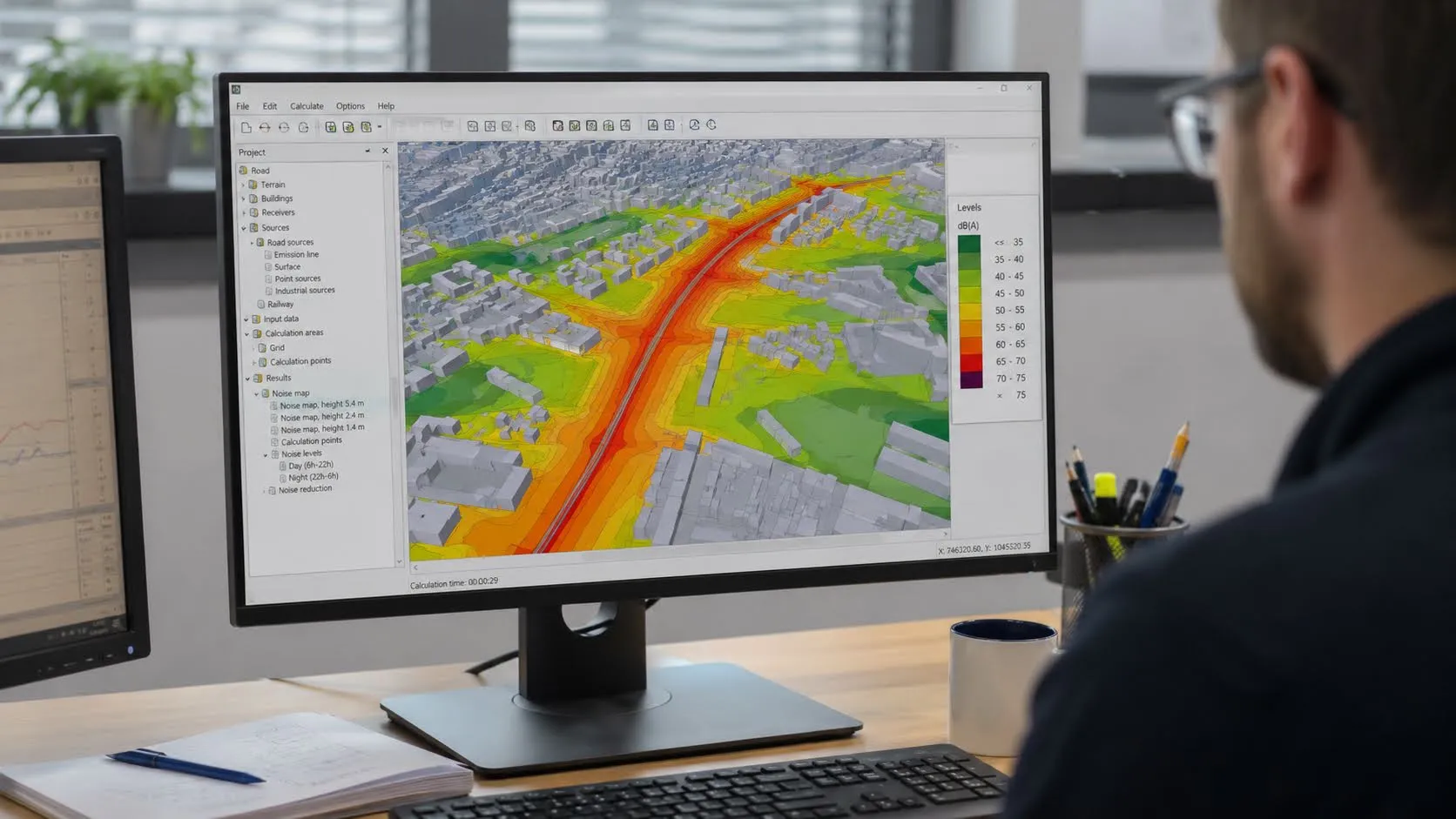
A noise study and noise measurement are not the same thing
In practice, two different outputs are often confused: a noise study and noise measurement. Both supporting documents concern noise, but they serve different purposes.
A noise study is a computational or modelling assessment. It is used mainly when a project is being prepared, designed, or permitted. The study estimates in advance how noise from sources will manifest in protected outdoor or indoor space.
Noise measurement verifies the actual state. It is carried out on real operation, equipment, or transport. The result is a measurement report documenting measured noise levels under specific conditions.
Simply put: a noise study answers the question "what can be expected", while noise measurement answers the question "what is the actual state".
Basic difference between calculation and measurement
| Supporting material | When it is used | What it documents |
|---|---|---|
| Noise study | Before project implementation, during design, permitting, or proposal of measures | Expected noise impact of sources on the surroundings |
| Noise measurement | After equipment installation, during operation, commissioning, or complaint | Actually measured noise level at specific locations |
| Acoustic assessment | May combine calculation, technical data, and expert evaluation | Suitability of solution, expected impacts, or proposal of measures |
| Control measurement | When limit exceedance is suspected or at request of the public health authority | Verification of actual state of operation |
Calculation is appropriate in the preparation phase. Measurement is appropriate when the noise source already exists and can be operated in a representative regime.
When a noise study is needed
A noise study is usually addressed where it is necessary to demonstrate in advance that a project will not excessively burden the surroundings with noise.
It is typically prepared for, for example:
- new industrial or production operations,
- changes to existing facilities,
- heat pumps,
- outdoor HVAC units,
- cooling units,
- compressors,
- transformer stations,
- boiler plants,
- loading ramps,
- car parks,
- site transport,
- facilities close to residential development,
- projects addressed within EIA or permitting proceedings.
A noise study is particularly appropriate when the project can still be adjusted. For example by changing equipment location, adding noise control measures, limiting night operation, moving the noise source farther from residential buildings, or proposing a more suitable technical solution.
When noise measurement is needed
Noise measurement is carried out when the actual state needs to be verified. A manufacturer's catalogue value or project calculation alone is therefore not enough. It is necessary to find out how the specific noise source actually manifests at the given location.
Noise measurement is typically addressed:
- during commissioning,
- after installation of a heat pump or HVAC unit,
- after putting a facility into operation,
- in response to neighbour complaints,
- during inspection by the regional public health authority,
- when verifying effectiveness of noise control measures,
- when operating hours change,
- when technology changes,
- when hygiene limits are suspected to be exceeded.
Measurement makes sense only if the source can be operated in a representative regime. For facilities it is therefore important to agree in advance under what conditions measurement should be carried out: day or night period, usual capacity, maximum operation, equipment switched on, transport, or a specific operating situation.
Commissioning: a study is not always enough
For commissioning, a noise study, noise measurement, or both may be needed. It depends on what the building authority, regional public health authority, or other affected body requires.
Typical situations:
| Situation | Suitable supporting material |
|---|---|
| Project is being permitted | Noise study or acoustic assessment |
| Technology is already installed | Noise measurement |
| Regional public health authority wants to verify compliance with conditions after implementation | Noise measurement |
| Project has changed compared with the original study | Update of noise study or new measurement |
| Noise control measures were proposed | Measurement of measure effectiveness after implementation |
If the actual state after implementation is being documented at commissioning, noise measurement is often more convincing than calculation alone. Conversely, before construction or equipment installation the actual state cannot be measured, and a noise study is therefore used.
Noise complaints
In a noise complaint it is usually necessary to establish whether the problem is real, which noise source causes it, and whether noise can be assessed objectively.
This typically concerns:
- noise from a facility,
- noise from a heat pump,
- noise from an HVAC unit,
- noise from cooling equipment,
- noise from a compressor,
- noise from loading and unloading,
- noise from transport on site,
- noise from night operation.
For complaints it is often important to determine correctly when measurement should take place. If a neighbour complains mainly about night noise, daytime measurement may not capture the problem. If noise is irregular, operating situations to be verified must be described in advance.
In a complaint, an expert inspection and preliminary assessment sometimes help first. Only then does it make sense to propose the exact scope of measurement or measures.
Heat pumps
Heat pumps are today one of the most common sources of noise problems at family houses, apartment buildings, guesthouses, and smaller facilities.
The problem is often not just the noise level stated in the catalogue. The following are also important:
- location of the outdoor unit,
- distance from windows of neighbouring buildings,
- operation at night,
- noise reflection from façades,
- tonality or disturbing character of noise,
- defrosting regime,
- simultaneous operation of several units,
- mounting on the building structure,
- transmission of vibration into the building.
For a newly proposed heat pump, acoustic assessment before installation is appropriate. For an already installed unit, noise measurement is usually carried out when problems arise.
HVAC units and rooftop technology sources
Ventilation units, fans, coolers, air conditioning, and other rooftop technologies can be a significant source of noise especially at night. A common problem is that only the output of the equipment is assessed, while its location and simultaneous operation of several sources are considered less.
For HVAC units it is important to know:
- acoustic power of the equipment,
- operating regime,
- day and night operation,
- position on the roof or façade,
- height of the source above ground,
- distance to the nearest protected development,
- any noise attenuators,
- direction of exhaust and intake,
- simultaneous operation of several units.
Before installation, a noise study is appropriate. After installation, at commissioning, or in a complaint, noise measurement is appropriate.
Facilities and industrial sites
At facilities, noise often does not come from a single source but from several partial influences. This may involve technology inside the building, doors, ventilation, compressors, material handling, forklift trucks, heavy goods transport, or loading.
This is typically addressed for, for example:
- production halls,
- paint shops,
- workshops,
- car repair shops,
- warehouses and logistics sites,
- restaurants and catering operations,
- car washes,
- joinery shops,
- metalworking,
- recycling and waste facilities.
For a new facility it is appropriate to assess noise in advance. For an existing facility, measurement is appropriate in a complaint or inspection. For more complex sites the best approach may be a combination of both: first measurement of the actual state and then a computational proposal of measures.
Transport as a noise source
Transport is often an independent or related noise source. For some projects the transport impact is even more significant than the technology itself.
Transport noise is addressed mainly at:
- new roads,
- car parks,
- logistics sites,
- industrial sites,
- warehouses,
- recycling operations,
- landfills,
- shopping centres,
- facilities with frequent heavy goods vehicle service.
For acoustic assessment of transport, the following are especially important:
| Data | Why it matters |
|---|---|
| Number of vehicles | Determines traffic intensity |
| Share of heavy goods vehicles | Heavy vehicles have a more pronounced noise impact |
| Day and night operation | Night transport is often more sensitive in assessment |
| Vehicle routes | Determine which protected locations may be affected |
| Driving speed | Affects traffic noise emission |
| Road surface | Asphalt, paving, or uneven surface produce different noise |
| Loading and handling | May be more significant than the vehicle pass-by itself |
For transport it is important to distinguish whether it is public road, site transport, car park, handling area, or a combination of several sources.
Why a manufacturer's catalogue value is not enough
For heat pumps, HVAC units, fans, or technological equipment, customers often assume that a catalogue noise value is sufficient. In reality it is only one of the inputs.
For noise assessment the following are also important:
- whether acoustic power or sound pressure is stated,
- at what distance the value was determined,
- in what operating regime the equipment works,
- whether the equipment will operate at night,
- whether noise reflects from façades,
- whether there are several similar sources nearby,
- where the nearest protected spaces are,
- whether vibration is transmitted into the structure.
A catalogue value can therefore be useful for calculation, but on its own it usually does not demonstrate compliance with hygiene limits at a specific location.
Measurement and assessment according to methods and standards
Both noise measurement and assessment must be carried out professionally. It is not enough to measure noise with a mobile phone or ordinary app and treat the result as evidence.
In professional measurement the following are addressed in particular:
- correct measuring equipment,
- instrument calibration,
- microphone position,
- measurement duration,
- operating regime of the source,
- influence of background noise,
- meteorological conditions,
- choice of protected space,
- measurement uncertainty,
- correct evaluation of the result.
The measurement result must be assessed according to the relevant methods, technical standards, and legal requirements. It is also important to distinguish whether measurement is in protected outdoor space, protected outdoor space of a building, or protected indoor space of a building.
What supporting materials to send
For a quick assessment of whether you need a noise study or noise measurement, it is advisable to provide mainly:
| Supporting material | Why it matters |
|---|---|
| Requirement from regional public health authority or building authority | Shows what output must be documented |
| Project documentation | Helps assess the project before implementation |
| Layout with noise sources marked | Enables determination of distances and affected locations |
| Equipment data sheets | Contain acoustic parameters of equipment |
| Operating hours | Distinguishes day and night operation |
| Technology description | Helps identify noise sources and their regime |
| Transport data | Necessary for assessment of transport noise |
| Photographs of equipment or operation | Help for existing sources and complaints |
| Information on the complaint | Important for choice of time and place of measurement |
The more accurate the input data, the better it is possible to determine whether a noise study, noise measurement, or a combination of both procedures is appropriate.
Practical decision: study, measurement, or both?
| Situation | Recommended approach |
|---|---|
| Equipment is being designed | Noise study |
| Equipment is already installed and actual state is to be verified | Noise measurement |
| Commissioning is being addressed | Study, measurement, or both according to authority requirement |
| Complaint is being addressed | Usually noise measurement, possibly followed by proposal of measures |
| Project is changing | Update of noise study |
| Noise control measure is being proposed | Computational assessment and, after implementation, possibly measurement |
| Complex site with several sources | Combination of measurement, calculation, and proposal of measures |
In many cases it is not a choice of either study or measurement. For more complex operations the correct approach may be first a noise study, then implementation of measures, and subsequently measurement of the actual state.
Summary
A noise study is appropriate especially when a project is being prepared, designed, or permitted. It helps assess in advance whether the proposed solution can meet noise protection requirements.
Noise measurement is appropriate when the source is already in operation and the actual state needs to be verified. It is typically addressed at commissioning, in complaints, inspections, technology changes, or after installation of a heat pump, HVAC unit, or other noise source.
Send us a requirement from the regional public health authority, project documentation, equipment data sheets, or a description of the problem and we will verify whether a noise study, noise measurement, or a combination of both procedures is more appropriate for your case.