
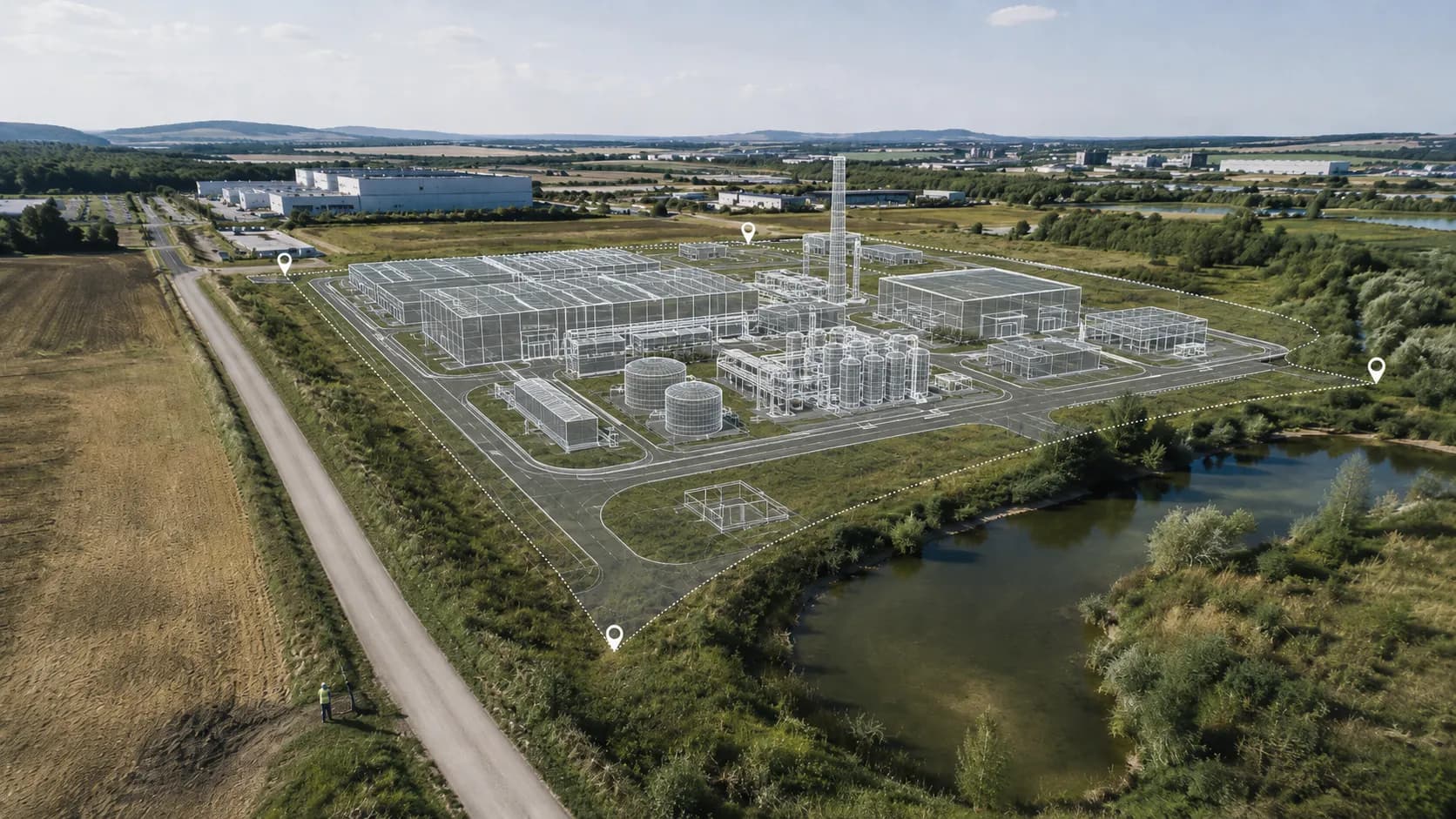
For industrial and technical projects, resolving only the building and technology part is not enough. Already in an early phase, exhaust placement, noise sources, traffic routes, protective setbacks, and operating capacity may decide the outcome. An environmental consultant helps the designer verify what documentation will be needed for air, noise, EIA, JES, and authority communication so the project does not have to be reworked unnecessarily later.
CONTENTS
Why addressing the environment only at the end of the project is not enough
The designer designs the building, technology, layout, object connections, and technical solution. The environmental consultant looks at the same project differently: how operation will affect the surroundings, what emission and noise sources will arise, whether the project falls under EIA, whether a unified environmental opinion will be needed, dispersion study, noise study, expert opinion, operating rules, or source operating permit.
The problem arises when the environmental part is addressed only after the project is finished. By then exhausts, HVAC units, stacks, traffic connections, technology layout, or outdoor noise source placement are often fixed. If it then turns out that the exhaust is too low, technology is close to residential development, or a measurement location is missing, it is no longer a minor administrative adjustment but a project intervention.
Environmental assessment has the greatest value before the project is "finished". Early specialist input often saves rework of exhausts, noise measures, traffic solutions, or permitting documentation.
This typically applies to paint shops, boiler plants, diesel generators, wood-processing plants, welding shops, recycling sites, waste facilities, automotive operations, HVAC units, heat pumps, compressor rooms, chemical storage, or operations with significant traffic.
Designer and environmental consultant have different roles
The designer addresses technical building and technology execution. The environmental consultant adds a view on project permitability from environmental and public health protection perspectives. The aim is not to "tell the designer how to design" but to flag in time where problems may arise in authority negotiations or subsequent operation.
| Area | Designer typically addresses | Environmental consultant verifies |
|---|---|---|
| technology | layout solution, connections, output, operational links | emissions, noise, waste, water, operating regime |
| exhausts | HVAC routes, stacks, facade, roof | dispersion, measurability, source classification, immission impact |
| noise sources | equipment placement, technical parameters | impact on protected spaces, day/night operation |
| traffic | site connection, logistics | HGV intensity, noise, dust, EIA |
| documentation | building and technical solution | JES, EIA, opinions, studies, operating rules |
| authorities | building proceedings and project documentation | regional authority, regional public health authority, CEI, nature protection, EIA body |
Good cooperation works when the environmental consultant does not arrive only with a finished list of problems but helps the designer choose a technical solution that will be more defensible.
Risk of project rework
The greatest risk arises where environmental requirements affect the physical building design. Typically this concerns exhausts, stacks, HVAC, noisy equipment, outdoor technology, traffic routes, storage areas, and operation placement relative to residential development.
If the problem is identified in time, a project-wise simple adjustment often suffices. If identified late, it may mean changing the roof, facade, technology, site layout, or operating regime.
| Problem identified late | Possible project impact |
|---|---|
| low or poorly placed exhaust | stack, HVAC route, or discharge height change |
| missing measurement location | duct, platform, access, and safety modification |
| noisy HVAC unit near residential development | silencers, equipment relocation, acoustic enclosure |
| underestimated traffic | noise or dispersion study rework |
| unverified EIA | permitting schedule delay |
| poorly described capacities | application supplementation and document inconsistency |
In practical terms: environmental requirements are not just a project annex. They often influence the technical solution itself.
Exhaust placement
Exhausts are one of the most common places where project and environmental requirements meet. The designer naturally addresses duct routing, buildability, and coordination with other disciplines. From air protection, exhaust height, discharge direction, flow rate, temperature, technology connection, measurability, and relationship to surrounding buildings must also be addressed.
An exhaust from a paint shop, boiler plant, diesel generator, welding shop, or wood-processing plant cannot be assessed like ordinary hall ventilation. If the exhaust removes process emissions, a dispersion study, emission measurement, or source operating permit may be needed.
Future measurement also matters. If the exhaust is in a poor position, without access, without a measurement port, or without a suitable measurement profile, problems may arise during authorised emission measurement. This is typically something relatively easy to solve in the project but difficult after construction.
Noise sources
For noise, the biggest mistake is focusing only on main technology inside the hall. In practice outdoor or semi-outdoor sources often decide: HVAC units, fans, compressors, cooling equipment, exhausts, intakes, loading, handling equipment, doors, conveyors, or reversing alarms.
A noise study needs specific acoustic parameters of sources, their placement, operating time, and relationship to protected outdoor spaces of buildings. If this data is unavailable, the study works with estimates and must be more conservative. That can lead to stricter measures or a requirement to supplement data.
It is appropriate to address already in the project especially:
- whether noisy sources will also run at night,
- whether outdoor units face residential development,
- whether doors will be open during operation,
- whether a light hall envelope will transmit technology noise,
- whether traffic will pass protected objects,
- whether noise silencers, enclosures, or barriers are designed.
Noise is a typical area where early coordination saves money. Moving an HVAC unit to another part of the roof is easy in the project. Retrofit soundproofing after neighbour complaints is more expensive and less elegant.
Traffic
Traffic is sometimes treated in the project as a logistics question. From environmental and public perspectives it can be one of the main project impacts. For industrial operations, recycling sites, warehouses, waste facilities, or production halls, not only annual volume but mainly daily intensities and routes must be known.
Traffic data enter noise studies, dispersion studies, EIA, and communication with the municipality. If the investor states a low number of HGVs and real operation later proves higher, credibility of the entire project is weakened.
For traffic it is appropriate to distinguish average day, peak day, seasonal operation, and extraordinary campaigns. For example, for a recycling centre, landfill, production with dispatch, or construction operation, annual capacity may not be sufficient for noise and dust assessment.
Protective distances and setback from sensitive locations
The term "protective distance" is used variously in practice. Sometimes it is a hygienic or safety setback, sometimes operational distance, fire link, immission impact, water source protection, setback from residential development, or suitable urban placement of technology.
For industrial projects it is important not to expect all problems to be solved by the site boundary alone. Noise, odour, dust, emissions, or traffic can affect surroundings beyond the investor's land. Therefore relationship to nearest residential buildings, schools, healthcare facilities, recreational objects, watercourses, protected areas, or existing operations is addressed already in the design.
Practically important: the cheapest measure is often correct placement. Technology shifted by tens of metres, an exhaust led above the roof, or traffic routed away from a residential street can matter more than subsequent technical measures.
EIA, JES, and permitting follow-on
For larger or more sensitive projects it is necessary from the start to verify whether the project enters EIA or screening procedure. This applies not only to new buildings but also to changes to existing operations, capacity increase, waste type expansion, new technology, or operating regime change.
The unified environmental opinion is today an important basis for project permitting under the Building Act. That does not mean the environmental part simplifies to one page. JES procedurally concentrates selected environmental acts, but substantively correct documentation must still be submitted.
| Situation | What to verify in time |
|---|---|
| new industrial operation | EIA, JES, air, noise, water, waste |
| technology change | whether operating permit change or EIA project change |
| new exhaust | source classification, dispersion study, measurement location |
| new HVAC or cooling | noise at protected space boundary |
| traffic increase | noise, air, EIA, traffic documentation |
| new waste facility | waste, EIA, air, water, operating rules |
Designer and investor should be clear whether environmental documentation will go into JES, EIA, source operating permit application, waste permit, water part, or as separate documentation for the regional public health authority or regional authority.
Authority communication
Early authority communication does not mean sending unfinished and unclear documentation. It means preparing a substantively consistent project description and verifying what process the authority will expect. For more complex projects it pays to align in advance especially capacities, exhausts, operating time, traffic, noise measures, and study scope.
The environmental consultant often acts here as a translator between project technical language and authority requirements. They can point out that the authority will be interested not only in machine output but also operating time, emissions, exhaust, noise, wastewater, or link to nearest protected objects.
Good authority communication rests on three things: consistent documentation, substantively supported data, and a realistic operating scenario. If the project, noise study, dispersion study, and application state different capacities or different operating hours, the project appears unreliable.
When to involve a specialist
A specialist on air, noise, or EIA should be involved already when choosing the variant and layout solution, not only when completing the application. At the latest they should enter when technology placement, exhausts, HVAC, traffic connection, and operating capacity are decided.
The environmental consultant has the greatest benefit especially for projects containing any of these elements:
- process exhausts,
- combustion sources,
- painting, bonding, or VOC,
- dust technologies,
- outdoor HVAC and cooling,
- significant HGV traffic,
- night operation,
- nearby residential development,
- waste or recycling,
- possible EIA or screening procedure.
The more of these elements a project contains, the greater the risk that late environmental review will reveal a problem only when the project is difficult to change.
Most common mistakes
The most common mistake is separating the project from permitting documentation. The project is prepared according to technical logic and environmental studies are to be "added somehow". If studies show the technical solution is unsuitable, the project must go back.
A second common mistake is underestimating operating scenarios. The project states annual capacity but studies need daily maxima, operating time, trip counts, technology hours, night operation regime, and specific noise or emission sources.
A third mistake is general authority communication without clear documentation. A question such as "will EIA be needed?" without capacity, technology, location, and traffic data cannot lead to a reliable answer.
Practical procedure
The first step should be a simple environmental screening. It verifies whether the project contains listed air sources, whether a dispersion study, expert opinion, noise study, EIA, JES, waste or water documentation may be required.
Next, review the project together with designer and investor. The aim is not a long requirements list but flagging specific points that may affect permitting: exhausts, HVAC, noisy sources, traffic, capacities, storage, water, and waste.
Only then prepare studies, opinions, and applications. This approach is faster than the opposite model where the project is finished first and only then permitability is checked.
Summary
Designer and environmental consultant should not work separately on an industrial project. The designer knows the technical solution; the environmental consultant watches impacts on air, noise, EIA, JES, operating conditions, and authority communication. The greatest benefit of this cooperation is in the early project phase when exhausts, noise sources, traffic routes, or technology placement can still be easily adjusted.
Early specialist involvement reduces risk of project rework, application supplementation, and permitting delay. For projects with process exhausts, significant noise, traffic, waste, emissions, or possible EIA, environmental screening should be part of project preparation from the start.
Send us the basic site situation, technical operation description, capacities, exhausts, HVAC, traffic data, and location of nearest residential development. We will verify when it is appropriate to involve an air, noise, or EIA specialist and what documentation to prepare for authority negotiations.
Factual basis of the article
The article is based mainly on these sources:
- Act No. 148/2023 Coll., on the unified environmental opinion,
- Ministry of the Environment methodological guideline on the unified environmental opinion,
- Act No. 100/2001 Coll., on environmental impact assessment,
- Act No. 201/2012 Coll., on air protection,
- Government Regulation No. 272/2011 Coll., on protection of health from adverse effects of noise and vibration.
The Act on the unified environmental opinion regulates JES as a binding opinion on project environmental impacts. The Ministry of the Environment guideline describes JES as a tool for procedural integration of environmental acts for projects permitted under the Building Act and for EIA projects. The Environmental Impact Assessment Act sets the EIA and screening regime. The Air Protection Act and its Annex 2 are the basis for assessing listed stationary sources, dispersion studies, expert opinions, and operating rules. Government Regulation No. 272/2011 Coll. is the basic regulation for assessing noise in protected spaces.