
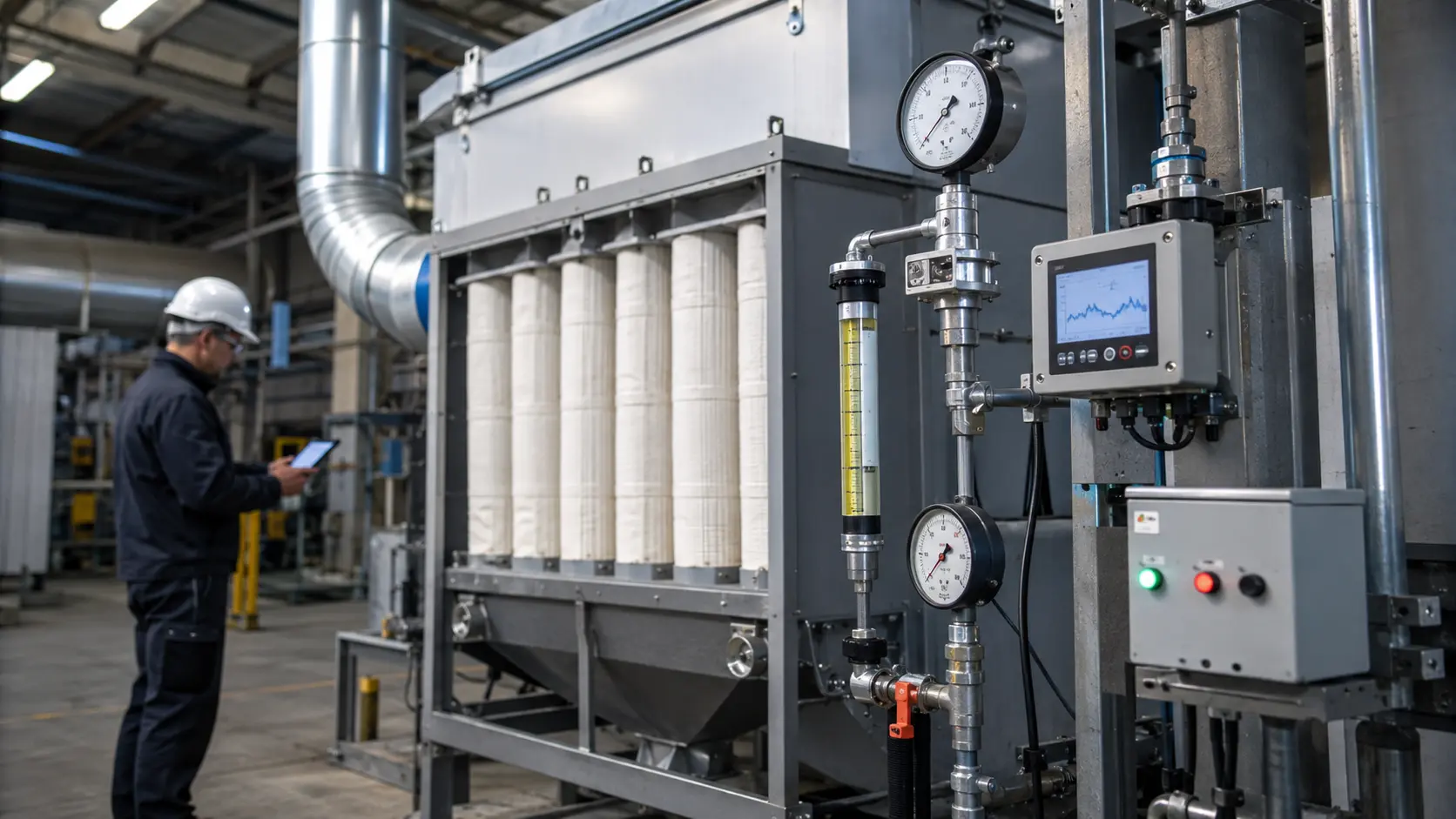
Why operating parameters are addressed
For many emission sources, attention used to focus mainly on one-off emission measurements. The operator commissioned authorised measurement, obtained a protocol, and thereby demonstrated whether the source met the emission limit at the time of measurement.
That may not always be sufficient. If a source meets an emission limit thanks to a filter, separator, afterburner, wetting system, or other measure, it is important to demonstrate that this equipment or measure also functions during normal operation — not only on the day of measurement.
That is what an operating parameter is for. It is not a new emission limit, but a technical value that helps verify on an ongoing basis that emission reduction technology or measures are functioning correctly.
Emission measurement shows the status at the time of measurement. An operating parameter helps demonstrate that emission reduction equipment or measures also functioned during normal operation.
Who the obligation may apply to
The obligation to monitor and record an operating parameter may apply especially to sources where pollution levels are determined by regular one-off emission measurements and where emission reduction technology or other measures are important for meeting emission conditions.
This may typically involve:
- paint shops with filtration, separation, or afterburning,
- exhausts with particulate filters,
- wood-processing plants with extraction and filtration,
- welding shops, grinding shops, and surface treatment with filtration equipment,
- combustion sources with emission reduction technology,
- plants with sorbent or chemical dosing,
- crushing, sorting, and recycling plants with dust control measures,
- technologies where meeting emission conditions depends on a specific operating regime.
The obligation is not assessed solely by technology name. What matters is the specific source, its classification, operating permit, method of emission measurement, and whether technology or measures used to reduce emissions must be continuously controlled.
What operating parameter may be appropriate
A suitable parameter must make technical sense. It should be measurable, recordable, and usable to verify that emission reduction equipment is working correctly.
| Technology or measure | Example of a suitable parameter |
|---|---|
| fabric, cartridge, or bag filter | pressure drop, fan operation, filter status |
| wet scrubber or gas washer | liquid flow, pH, conductivity, pressure, pump operation |
| thermal or catalytic afterburning | temperature, unit operating status, possibly other operating data |
| sorbent or reagent dosing | quantity of dosed reagent, dosing equipment operation |
| process extraction | air flow, negative pressure, fan operation |
| wetting of dusty operations | wetting operation, water pressure, frequency or duration of wetting |
| enclosure or sealing of technology | closure status, damper position, operating regime |
For particulate filters, pressure drop is often important in practice. A value that is too low or too high may indicate leakage, damaged filter media, filter clogging, or a flow problem.
For afterburners, temperature is essential. For wetting, what matters is whether the measure actually runs when dusty activity is taking place. For wet scrubbing, it is not enough to know that the equipment exists. It is necessary to demonstrate that the working liquid circulates and that operating conditions match the required regime.
Difference between emission measurement and operating parameter
Emission measurement and monitoring of an operating parameter serve different purposes.
Emission measurement verifies what concentrations or mass flows of pollutants the source releases at the time of measurement. A protocol from authorised measurement is an important basis for demonstrating compliance with the emission limit, operating records, operating permit, and inspection.
An operating parameter, by contrast, does not serve to determine emission quantities directly. It monitors whether emission reduction technology or measures are in the appropriate operating state.
In practice, a filter may show a good result during emission measurement. But if the operator has no records of its normal operation, pressure drop, maintenance, or filter element replacement, it may be difficult during inspection to demonstrate that filtration was properly operated outside the measurement day.
Where to look for the obligation
The first document to check is the operating permit. It should state binding operating conditions, including how pollution levels are determined, emission measurements, operating restrictions, and possibly monitoring of operating parameters.
When reviewing the permit, focus especially on whether:
- the source is correctly classified under Annex 2 to the Air Protection Act,
- regular one-off emission measurement is required,
- emission reduction technology or measures are in place,
- a specific operating parameter is stated in the permit,
- how the parameter is to be monitored and recorded is specified,
- usual or limit values are stated,
- the permit matches the actual technical state of the source.
For older permits, conditions may not be described sufficiently specifically, or technology may have changed since the permit was issued. In such cases, it is advisable to verify whether an update of the operating permit or operating rules is needed.
What if a suitable parameter cannot be set
Some sources do not have a simple technical value that would clearly demonstrate correct functioning of emission reduction measures. That does not mean ongoing control is not addressed at all.
If a suitable operating parameter cannot be set, a technical condition ensuring equivalent control may be specified in the operating permit. This may involve a specific operating regime, inspection frequency, maintenance rules, cleaning records, equipment operation records, operating restrictions under certain conditions, or another verifiable condition.
The condition must be practically feasible and verifiable. A general statement without a method of control is usually insufficient.
What records should look like
Records must be kept so that source operation and functioning of technology or measures can be demonstrated retrospectively. It is not enough to state verbally that equipment was running.
Depending on the type of operation, this may involve:
- automatic records from the control system,
- data logger,
- regular manual entries in an operating log,
- output from a meter or sensor,
- operating hours records,
- records of equipment start-up and shutdown,
- records of inspection, maintenance, or filter replacement,
- records of wetting or other measure operation.
For manual records, date, time, parameter value, equipment status, name of responsible person, and any note on deviation, maintenance, or fault should be clear.
Most common mistakes in practice
The most common problem is not the existence of a filter or separator itself, but inability to demonstrate its actual operation. Operators often assume that if equipment physically exists and the source met the limit during emission measurement, everything is in order. During inspection, however, demonstration of normal equipment operation may be required.
Common mistakes include:
- operating permit does not match actual technology,
- it is unclear which parameter should be monitored,
- the parameter is monitored but not recorded,
- records are kept irregularly or formally,
- values are not linked to actual source operation,
- records of faults, outages, and maintenance are missing,
- filter cartridge replacement or equipment servicing is not documented,
- operating rules do not describe how the parameter is monitored,
- operators do not know what to do in case of deviation,
- records are not traceable during inspection.
The best records are not the longest records. The best records are those that simply and credibly demonstrate that emission reduction equipment was operated correctly.
What the operator should check
Before inspection, emission measurement, or permit change, we recommend going through this short checklist:
- Does the source have an obligation for regular one-off emission measurement?
- Does the source have emission reduction technology or measures?
- Is an operating parameter stated in the operating permit?
- Does the parameter match actual technology?
- Is the parameter technically measurable and recordable?
- Is it specified how often it should be recorded?
- Do operators know which values are normal and when there is a problem?
- Are records stored and traceable?
- Is the procedure described in the operating rules?
- Are records usable during inspection by the Czech Environmental Inspectorate (CEI) or regional authority?
If there is no clear answer to any of these questions, it is advisable to review the permit, operating rules, and technical documentation.
What you can send us for assessment
If you are unsure whether you must monitor an operating parameter, send us the operating permit, operating rules, technical description of the filter, separator, afterburner, or other measure, latest emission measurement protocols, and a sample of operating records.
We will verify whether the obligation applies to your source, which parameter makes technical sense, whether it is appropriately stated in the operating permit, and how to record it so that records are usable during inspection. In unclear cases, we can prepare an expert opinion, draft amendment of operating rules, or documentation for operating permit change.
Summary
An operating parameter is a practical tool for ongoing demonstration of correct functioning of emission reduction technology or measures. It does not replace authorised emission measurement but complements it. Measurement shows status at the time of measurement, while an operating parameter documents normal operation of equipment or measures.
The most important thing is to work from the specific operating permit and actual technical state of the source. The operator should know which parameter is monitored, why it is monitored, how often it is recorded, and how records are stored. If a parameter cannot reasonably be set, another verifiable technical operating condition must be addressed.
Factual basis of the article
The article is based mainly on Act No. 201/2012 Coll., on air protection, as amended by Act No. 42/2025 Coll., and methodological information from the Ministry of the Environment on operating parameters.
| Source | Practical significance |
|---|---|
| Act No. 201/2012 Coll., on air protection | basic legal framework for obligations of stationary source operators |
| Act No. 42/2025 Coll. | amendment supplementing rules for monitoring and recording operating parameters |
| MoE FAQ on operating parameters | practical MoE interpretation of when the obligation arises and how to understand it |
| MoE – industry and energy in air protection | methodological information and updates on source operator obligations |
| operating permit of the specific source | determines binding operating conditions, emission measurements, and possible monitoring of operating parameters |
| operating rules | should describe practical implementation of specified operating conditions and record-keeping |
From a practical perspective, these sources show that operating parameters should not be addressed in isolation. It is always necessary to assess the specific source, its operating permit, method of emission measurement, emission reduction technology used, and real possibility of ongoing recording.
A correctly set operating parameter should be simple, technically justified, and verifiable. It must be clear what is monitored, why it is monitored, how the value is recorded, and how the operator proceeds in case of deviation, fault, or equipment outage.