
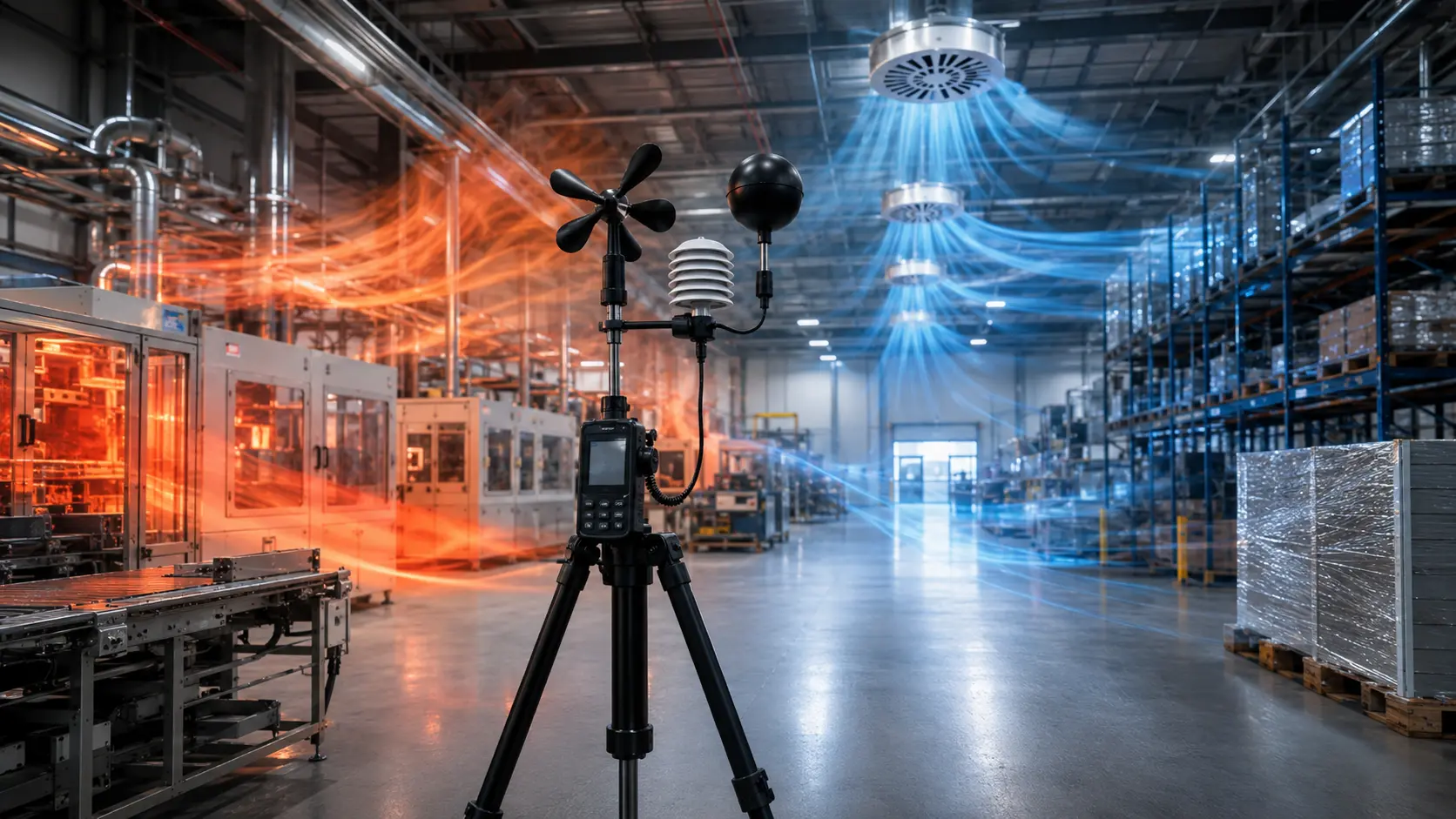
When workplace microclimate is addressed
Microclimatic conditions are among the important factors of the workplace environment. They affect thermal comfort, fatigue, concentration, employee performance and health risks at work. The problem usually appears as long-term heat, cold, draught, dry air, temperature fluctuations or different conditions between individual workstations.
Microclimate measurement is applied in production halls, warehouses, kitchens, offices, laboratories, operations with thermal load, refrigerated operations, air-conditioned spaces and workplaces where employee complaints recur.
Assessment always starts from the specific work, operating regime and actual conditions at the workplace. An air-conditioned office is evaluated differently from a production hall with technological heat sources and differently from a warehouse with frequent door opening.
What is evaluated during microclimate measurement
Microclimate is not only air temperature. For professional assessment it is important to monitor several quantities simultaneously and evaluate them in relation to work performed, shift pattern, season and technology operation.
| Quantity | Practical significance |
|---|---|
| Air temperature | basic information on temperature conditions at the place of work |
| Resultant or operative temperature | better reflects thermal effect of surrounding surfaces, radiation and air movement |
| Relative humidity | affects feeling of dryness, sweating and overall thermal comfort |
| Air velocity | relates to ventilation, draught and cooling of the worker |
| Differences between measurement locations | show unevenness of conditions in the space |
| Operating regime | explains relationship between measured values, technology and work organisation |
In offices, air conditioning, draught, dry air and differences between locations by windows, under air outlets and in the depth of the room are often addressed. In production halls, heat sources, doors, local ventilation, radiation from technology and seasonal differences are usually key. In kitchens, laundries, bakeries or operations with ovens, thermal load is assessed in particular. In warehouses, cold stores and dispatch areas, cold, air movement and transitions between temperature zones are addressed.
When to order measurement
We recommend measurement especially when routine operational assessment is not enough and the company needs an objective basis. This typically involves repeated employee complaints, suspicion of thermal or cold load, dealings with KHS, technology change, air conditioning adjustment, workplace reconstruction or documentation for job categorisation.
Measurement is also meaningful before investment in technical measures. Without data, often only an assumed problem is addressed. In practice the cause of discomfort may be poorly set ventilation, unsuitable workstation location, radiation from technology, local draught, open doors, insufficient shading or a combination of several influences.
Professional measurement makes it possible to determine where the problem arises, when it appears and which measure makes technical sense.
Significance of season and operating regime
Microclimate changes significantly according to season. Summer thermal load must be assessed in the period when it actually occurs. Cold conditions at doors, dispatch zones, warehouses or cooling spaces are evaluated in corresponding winter or operationally loaded conditions.
Operating regime is equally important. During measurement we record whether technology was running, whether doors were open, how ventilation was set, whether air conditioning was operating, what the shift was and whether operation corresponded to normal or critical state.
For variable operations we design measurement locations and duration so that they capture decisive work situations. In larger halls or office spaces several locations are usually measured, because conditions can differ significantly even within one room or operating zone.
Measurement outputs
The output is a report or expert documentation containing identification of workplaces, description of work activities, operating regime during measurement, measurement equipment used, measurement locations, measured values and professional evaluation.
In the report the client will find in particular:
- description of measured spaces and work activities,
- measured values of temperature, humidity and air movement,
- assessment of results in relation to nature of work and operating conditions,
- evaluation of differences between individual locations or regimes,
- conclusion usable for OHS, KHS, job categorisation or measure design.
For workplaces with significant thermal or cold load the output may serve as a basis for adjustment of work regime, breaks, fluid intake, ventilation, air conditioning, shading, insulation of heat sources or change of work organisation.
Most common findings in practice
In offices, uneven air flow from air conditioning, differences between workstations or low air humidity are often confirmed. In production halls the problem is usually a combination of technological heat sources, insufficient ventilation, open doors and radiation from machines or material.
In warehouses and dispatch areas, flow of cold air during door handling often appears. In kitchens and operations with thermal technology, the actual regime of cooking, baking, washing or other thermal activity is usually decisive. In air-conditioned spaces, not only temperature setting matters, but also flow direction, air speed and workstation location.
Professional assessment is therefore always combined with local knowledge of the operation. Temperature value alone without context often does not explain the cause of the problem.
What you can send us for assessment
For measurement scope design send us a brief description of the workplace, activities performed, shift pattern, heat or cold sources, ventilation and air conditioning method, floor plan or simple sketch and description of situations when the problem appears most.
Based on this documentation we will propose the scope of microclimate measurement, suitable measurement locations, measurement date and operating regime under which measurement should take place. The result will be expert documentation usable for internal decisions, OHS, KHS, job categorisation or design of technical measures.
Summary
Microclimate measurement objectively assesses temperature, humidity and air movement at the workplace. It is used for employee complaints, suspicion of thermal or cold load, ventilation and air conditioning adjustments, workplace reconstructions and preparation of documentation for KHS, OHS or job categorisation.
Properly designed measurement takes into account type of work, shift pattern, season, operating regime, heat or cold sources and layout of workstations. Thanks to that the actual cause of the problem can be determined and measures proposed that match the specific workplace.
Factual basis of the article
The article is based on requirements for health protection at work, legal regulation of microclimatic conditions at the workplace and expert information from the National Institute of Public Health on thermo-humidity conditions of indoor workplace environments.
| Source | Practical significance |
|---|---|
| Government Regulation No. 361/2007 Coll. | sets conditions for health protection at work including requirements for risk factors of working conditions and microclimatic conditions |
| Act No. 258/2000 Coll., on public health protection | forms the basic framework of public health protection and supervision of working conditions |
| NIPH – microclimatic conditions of indoor workplace environments | explains significance of temperature, humidity and air movement in microclimate evaluation |
| Ministry of Health – job categorisation | describes job categorisation as a tool for evaluating influence of working conditions on employee health |
| Work environment – NATURCHEM | related service of workplace environment factor measurement including microclimate |
From a practical point of view, microclimate evaluation must work with the specific workplace, type of work, season, operating regime, heat or cold sources, ventilation, air conditioning and employee placement. Temperature, humidity and air movement are evaluated together, because their combination determines actual working conditions.