
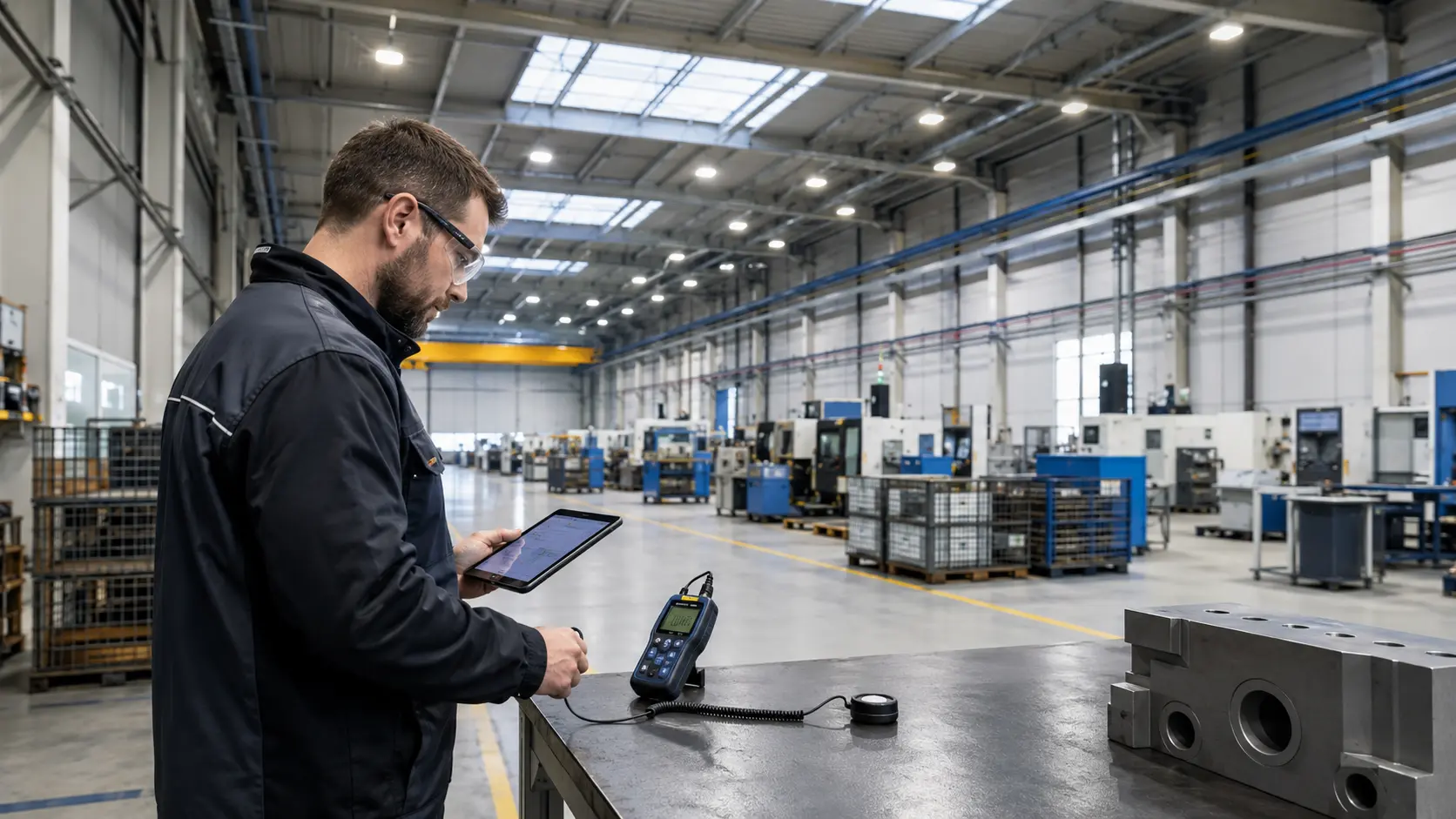
Who lighting measurement concerns
Lighting measurement concerns every operator, investor or designer addressing a new workplace, reconstruction, building approval, change of use or a request from the regional hygiene station. It typically involves production halls, warehouses, offices, schools, healthcare facilities, laboratories, workshops, administrative operations and employee facilities.
In practice it is not only a question of whether there is subjectively enough light in the room. At workplaces it is assessed whether lighting corresponds to the specific activity. Requirements differ for warehouse circulation, office work, product inspection, assembly of small parts, laboratory or classroom.
It is also important to distinguish whether artificial lighting, daylight or combined lighting is addressed. For building approval or KHS opinion the type of lighting to be documented may be decisive.
When KHS usually requires a lighting measurement report
KHS may require a lighting measurement report especially when it is necessary to demonstrate that the completed space meets hygiene requirements for work. This most often appears with new operations, changes of use, reconstructions, buildings for employees or spaces where visual demands of work are higher than usual.
For building approval, lighting measurement is a practical proof that not only the design assumption but the actually implemented state is evaluated. That is important especially when luminaires, room layout, technology, workstations or placement of furniture and machines changed during construction.
Practical note: If KHS states a lighting measurement report in requirements for building approval, do not wait with measurement until the last week before the deadline. If non-compliant conditions are found, there must be time to adjust luminaires, controls, workstation layout or supplementary lighting.
When measurement is needed for building approval
For building approval or putting a space into use it matters whether the building authority, KHS or another affected body has sufficient documentation to assess that the space can be used safely and hygienically. For workplaces, ventilation, noise or microclimate are often documented, but so is lighting.
A lighting design or photometric calculation may be important documentation, but does not always replace measurement. If the real state after installation needs to be verified, a measurement report is usually the most convincing. Conversely, where design is done well, luminaires and their layout correspond to the project and the calculation has sufficient reserve, simpler documentation may be possible in some cases. It always depends on the specific procedure and request of the relevant authority.
For the investor or designer it is therefore safest to verify the measurement requirement in time. Especially for schools, healthcare, production operations, office buildings and workplaces with permanent work, it is not appropriate to address lighting only formally at the end of construction.
What to check before ordering measurement
Before measurement the space must be in a state corresponding to normal operation. If measurement is carried out in an empty hall without technology, without work tables or before completion of electrical installation, the result may not correspond to actual working conditions.
Before measurement it is advisable to check mainly whether final luminaires are installed, whether they operate in standard operating regime, whether workstation layout is clear and whether purposes of individual rooms are known. The KHS, building authority or investor requirement is also essential, because that may determine what scope of report will be needed.
It is also important to know whether only overall room lighting or a specific visual task is to be measured. For example, in assembly, quality control or work with documentation a different plane and location may be evaluated than for ordinary circulation or warehouse space.
Most common mistakes from practice
The biggest problems do not arise because lighting cannot be measured. They arise because measurement is addressed late, without a clear brief or in a space that does not yet correspond to actual operation.
A common mistake is substituting design calculation for verification of actual state. Calculation shows how lighting should work according to design. Measurement shows how the space actually works after implementation. If luminaires, mounting height, workstation layout or technology changed during construction, the original calculation may no longer correspond to reality.
Another problem is underestimating uniformity, glare and shading. The operator often monitors only illuminance in lux, but working conditions may also be worsened by unsuitable light distribution, reflections, too dark surroundings of the workstation or shading by racks and technology.
In offices, work with display units is often forgotten. In production, routine equipment operation is sometimes wrongly distinguished from precise inspection or assembly activity. Correct determination of the visual task is essential for evaluation.
What output the client receives
The output is a lighting measurement report describing the measured object, measured spaces, measurement conditions, instrument used, measurement point layout, measured values and evaluation against applicable requirements.
The report may serve as documentation for KHS, building approval, change of use, internal OHS documentation, inspection of working conditions or as technical documentation for the designer. If measurement shows non-compliant values, practical recommendations on how to resolve the situation are also advisable.
It is not always necessary to redesign the entire lighting immediately. Sometimes adjustment of controls, supplementary local lighting, replacement of light sources, cleaning of luminaires, workstation layout change or supplementary luminaires in a problematic part of the space is enough.
What you can send us for assessment
For initial assessment a floor plan and brief description of workplaces is usually enough. If you already have an opinion or KHS request, it is advisable to send it too, because it may directly determine the scope of required documentation.
Most useful is to send a floor plan or simple space schematic, purpose of individual rooms, description of work activities, layout of workstations, machines, tables or racks and any KHS, building authority or designer request.
If you have a lighting design, photometric calculation, luminaire data sheets or photographs of the space, they help us determine the suitable measurement scope more precisely. For larger buildings it is advisable to divide spaces by type of activity, not only by room numbers.
Brief summary
Workplace lighting measurement should be addressed whenever building approval, change of use, new operation, lighting reconstruction or KHS inspection is being prepared. The operator should know that installing new luminaires alone is not enough. What matters is whether lighting corresponds to actual work, the specific space and requirements of legislation and technical standards.
Send us a floor plan, description of workplaces and any KHS request. We will verify whether measurement of artificial lighting, daylight, design review or a combination of several documents will be appropriate. In unclear cases we recommend addressing documentation in advance, before a problem arises at building approval or inspection.
More on workplace environment measurements is also on the page NATURCHEM Work environment.
Factual basis of the article
| Source | Practical significance |
|---|---|
| Government Regulation No. 361/2007 Coll. | Basic regulation for health protection at work. Contains requirements for workplace lighting, including link to daylight, electric and combined lighting. |
| Government Regulation No. 20/2025 Coll. | Amends GR No. 361/2007 Coll. and adjusts, among other things, requirements related to lighting verification. For new projects the current wording of the regulation must be used. |
| Decree No. 146/2024 Coll., on construction requirements | Addresses construction requirements for lighting, insolation and shading. Important especially for building approvals, changes of use and project preparation of buildings. |
| ČSN EN 12464-1:2022 | Basic technical standard for lighting of indoor workplaces. Sets requirements for visual tasks, spaces and activities in indoor work spaces. |
| ČSN 36 0011-1 and ČSN 36 0011-3 | Standard documentation used for lighting measurement procedures. Important for correct layout of measurement points, conduct of measurement and evaluation of results. |
| ČSN EN 1838 | Standard for emergency lighting. Applies where safety during failure of normal lighting must be addressed, for example on escape routes or risky workplaces. |
| KHS or building authority request | May be decisive in a specific procedure. It is therefore always advisable to work from the specific notice, opinion or conditions stated in documentation. |
From these sources it follows for the operator that lighting cannot be assessed only from subjective impression or from the fact that new LED luminaires were installed. Room purpose, nature of work, visual task, actual workstation layout and technical parameters of lighting are evaluated.
If project, actual implementation and future operation match, documentation may be simpler. If luminaires, layout, technology or manner of space use changed during construction, measurement is advisable and a report corresponding to actual state should be available.