
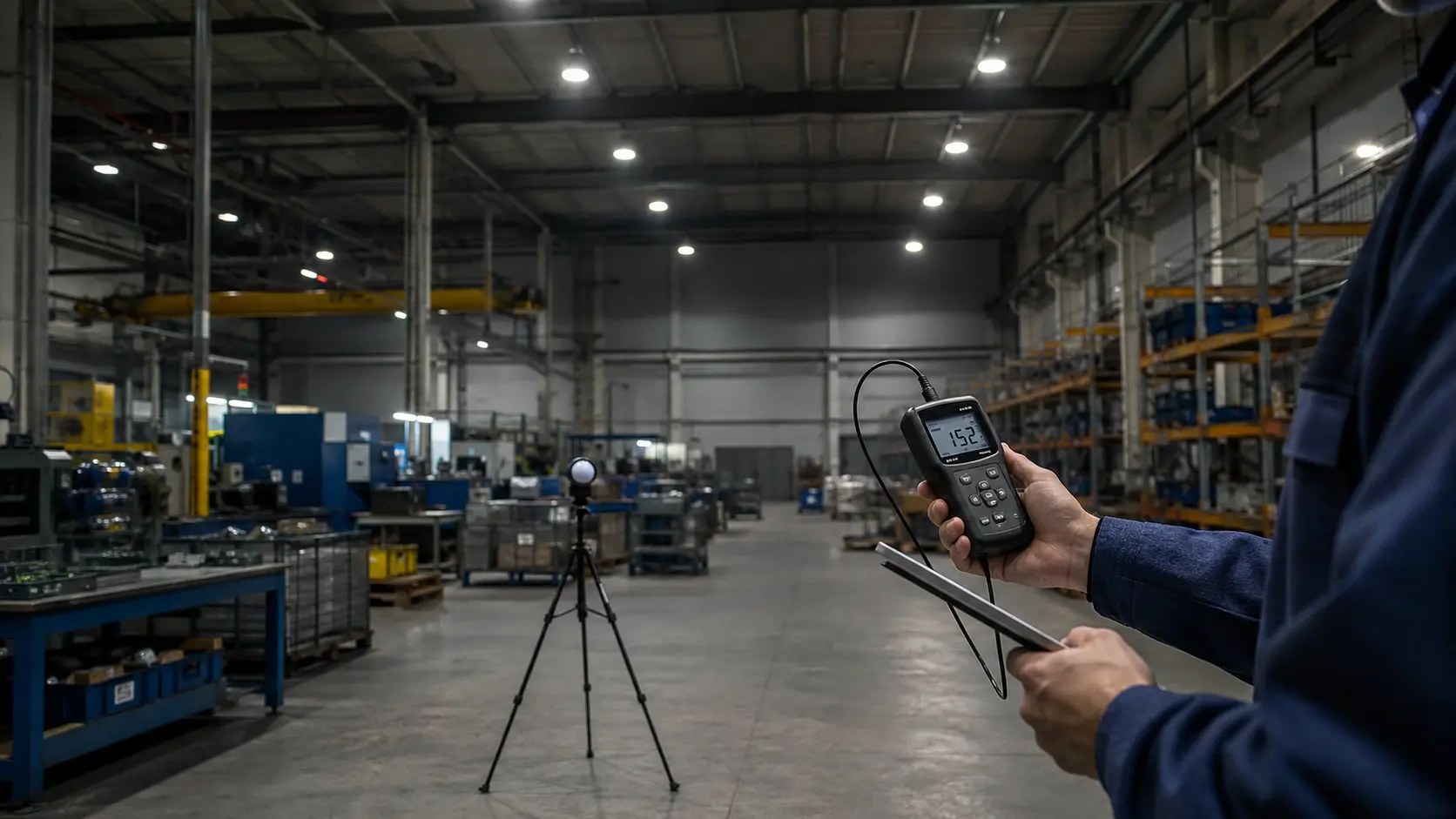
When insufficient lighting is a real problem
Insufficient workplace lighting is not just a matter of comfort. For many tasks it can affect visual strain, fatigue, work accuracy, safety of movement around the workplace, and overall working conditions. The problem may concern production halls, warehouses, offices, workshops, laboratories, schools, healthcare facilities, and ordinary employee facilities.
In practice, employees often do not describe the problem in technical terms. They may say, for example, that the space is dark, their eyes hurt, they cannot see details well, shadows form on the desk, lights dazzle them, or the difference between parts of the hall is too great. At such a moment it is important for the operator not to rely only on subjective impression, but to verify whether the lighting matches the actual work and the requirements of regulations and standards.
For a new workplace, reconstruction, or regional public health authority inspection, the situation is similar. It is not enough that new LED luminaires were installed or that the design includes a lighting calculation. What matters is whether the actually implemented state corresponds to the purpose of the space, the layout of workstations, and the visual demands of the work.
What is assessed during lighting measurement
During measurement, illuminance in lux is most often assessed — the amount of light falling on the working plane or the area under evaluation. For a workplace, however, it is not just a single numerical value. Uniformity of lighting, possible glare, reflections, shadows, the nature of the visual task, and the relationship between the workstation and its surroundings are also important.
For typical operations, artificial lighting is measured in particular. In some cases it may also be necessary to address daylight or combined lighting, i.e. a combination of daylight and artificial light. This is important mainly for new buildings, changes of use, schools, offices, healthcare spaces, or workplaces with continuous work.
A typical lighting measurement report does not only state how many lux were measured. It should describe the measured space, measurement points, measurement conditions, the instrument used, the operating regime of the lighting, and the evaluation against the relevant requirement. With a well-prepared measurement, it is clear where measurement was carried out, why exactly there, and according to what the result was assessed.
When the employer should pay attention
It is advisable to pay attention whenever lighting is addressed only after employee complaints or shortly before building completion. At that point there may no longer be room for a calm technical adjustment. The problem may be poorly designed luminaire layout, unsuitable mounting height, shading by racks or technology, insufficient local lighting, dazzle of workers, or large differences between light and dark zones.
In production operations, it is particularly risky when the original lighting design was prepared for an empty hall. After installation of lines, machines, piping, crane tracks, or storage racks, lighting conditions change. In offices, reflections on monitors, desk layout, and the difference between general room lighting and the employee's actual visual task are often underestimated.
Practical note: If a luminaire replacement, hall reconstruction, or change in workstation layout is planned, it is advisable to assess the intention first and only then measure the resulting state. Measuring the current unsatisfactory state makes sense mainly when you need to objectively document the problem and propose corrective measures.
Measure the current state, or only after lighting adjustment?
That depends on the reason lighting is being addressed. If there is an employee complaint, suspicion of unsatisfactory conditions, or an inspection requirement, it is usually appropriate to measure the current state. The result will show whether the problem is real, in which part of the workplace it arises, and how serious the deviation is.
If the operator already knows that lighting will be changed, it may be more useful to check the design of the adjustment first. Replacing luminaires without regard to work activity may not solve the problem. New luminaires may have higher output but unsuitable light distribution, poor optics, a dazzling effect, or unsuitable colour temperature. Therefore, for larger workplaces it is advisable to combine measurement, lighting design, and operational knowledge of the workplace.
| Situation | Suitable approach |
|---|---|
| Employee complaints about darkness, eye strain, or shadows | Measure the current state, identify problem areas, and propose adjustment based on the result. |
| New workplace before building completion | Verify the requirement of the regional public health authority or building authority and measure only in a state corresponding to future operation. |
| Planned luminaire replacement | Assess the design and type of work first; after implementation verify the actual state by measurement. |
| Hall reconstruction or technology change | Assess the new layout of workstations, machines, and racks; the original report may no longer apply. |
| Regional public health authority or OHS inspection | Prepare a measurement report and demonstrate that lighting corresponds to specific work activities. |
What documentation to prepare before measurement
To set the scope of measurement correctly, it is necessary to know mainly the purpose of the space and the type of work. It is not enough to send only the address of the building and a request to measure lighting intensity. The same room may be assessed differently depending on whether it is a warehouse, packing workplace, office, quality control, assembly, laboratory, or technology operation.
It is most useful to send a floor plan, a description of activities, workstation layout, information on shift work, and the authority's requirement, if one exists. Photographs of the space often help quickly identify risk areas: high racks, shading, dark surfaces, old luminaires, local work tables, crane tracks, or pronounced reflections.
For new or reconstructed operations, it is also advisable to add the lighting design, lighting calculation, luminaire data sheets, and information on whether luminaires are already installed in their final form. If the measurement is to be used for building completion, it is also important to send the specific requirement of the regional public health authority or building authority.
Most common mistakes from practice
A common mistake is to order measurement when the space is not yet ready. If final luminaires, work tables, racks, or technology are not installed, the report may describe a state that will not correspond to actual operation. Such a result may then not be usable for the regional public health authority or for internal assessment of working conditions.
A second common mistake is the belief that new LED luminaires automatically mean compliant lighting. In reality, what matters is their layout, optics, mounting height, control, maintenance, shading, and relationship to specific workstations. Replacing lights without assessing visual tasks can lead to some parts of the workplace remaining dark while others dazzle.
A third problem is unclear assignment. If it is not specified what work is carried out in the space, the correct requirement for evaluation cannot be selected. For assembly of small parts, quality control, or work with documentation, requirements may differ from those for an ordinary warehouse or circulation area.
What output the client receives
The output is a lighting measurement report that can be used as documentation for the regional public health authority, building completion, inspection of working conditions, internal OHS documentation, or a decision on lighting adjustment. The report should be understandable not only to a specialist but also to the operator, designer, or person who will address corrective measures.
If the result shows a non-compliant state, the aim is not merely to state non-compliance. What is practically important is to determine whether the problem arises from insufficient luminaire output, poor uniformity, shading, unsuitable workstation layout, reflections, or the overall lighting concept. Based on that, it can be decided whether a local adjustment is sufficient or whether a larger part of the lighting system needs to be redesigned.
What you can send us for assessment
For an initial assessment, send a floor plan or simple scheme of the space, a description of work activities, information on shift work, photographs of the workplace, and the requirement of the regional public health authority or building authority, if you have one. For larger operations it is advisable to mark where permanent workstations are, where inspection, assembly, or work with documentation is carried out, and which parts of the space serve only as circulation or storage.
If you do not yet know whether to measure the current state or the state after luminaire replacement, also send a brief description of the planned adjustment. We will check whether it is appropriate to carry out measurement first, assess the lighting design, or wait until the final state after implementation.
More on workplace environment measurements can be found on the NATURCHEM Work environment page.
Brief summary
Insufficient workplace lighting should be addressed professionally and in good time. It is not just a matter of lux levels, but of actual working conditions, visual demands of work, lighting uniformity, glare, shadows, and the link to the specific space. The operator should be clear on whether they need to document the current state, prepare documentation for the regional public health authority, verify the workplace before building completion, or check the design of a luminaire replacement.
Send us a floor plan, description of activities, photographs of the workplace, and any authority requirement. We will verify whether it is appropriate to measure the current state, or whether it makes more sense to adjust the lighting design first and measure only the final implementation.
Factual basis of the article
| Source | Practical significance |
|---|---|
| Government Regulation No. 361/2007 Coll. | Basic regulation for health protection at work. For workplace lighting it sets the framework of requirements and refers to technical standards for specific values and procedures. |
| Government Regulation No. 20/2025 Coll. | Amends Government Regulation No. 361/2007 Coll. and adjusts certain requirements related to verification of lighting, control of values, and links to technical standards. |
| Decree No. 146/2024 Coll., on building requirements | Important for buildings, building completion, and changes of use. It addresses, among other things, requirements for lighting, insolation, and shading according to the purpose of use of the building. |
| ČSN EN 12464-1 | Basic standard for lighting of indoor work spaces. It sets requirements for visual tasks, spaces, and activities, including work with display units. |
| ČSN 36 0011-1 and ČSN 36 0011-3 | Standard sources for lighting measurement procedures. They are important for correct determination of measurement points, carrying out measurement, and evaluating results. |
| ČSN EN 1838 | Standard for emergency lighting. It applies especially where safety during failure of normal lighting needs to be addressed. |
| Requirement of the regional public health authority, building authority, or investor | In a specific case it may determine what scope of measurement and what type of report will be needed. It is therefore advisable always to proceed from the specific notice, opinion, or assignment. |
From the above sources it follows that workplace lighting must be assessed according to the actual purpose of the space and the work performed. Legal regulations set the obligation to ensure safe and health-preserving working conditions, while technical standards provide specific values and procedures for assessing lighting.
In unclear cases it is advisable to assess documentation in advance. If the problem is identified only during an inspection, building completion, or after an employee complaint, the solution is usually more demanding in terms of time and operation.