
Why ISPOP matters for emission measurement
One-time emission measurement is not just a technical visit by a measurement team to an exhaust. To be usable for fulfilment of a statutory obligation, it must be correctly prepared, carried out and notified.
From 2026, ISPOP uses separate forms for notification of the date of one-time emission measurement and for notification of data from the report. Operators therefore need to know who ensures what, what data are needed in advance, and how to proceed when the date changes.
The most common problem is not the measurement itself. Problems arise when it is unclear who was to notify the date, whether notification was made in time, which exhaust was to be measured, and whether measurement took place under the correct operating regime.
Who has which role
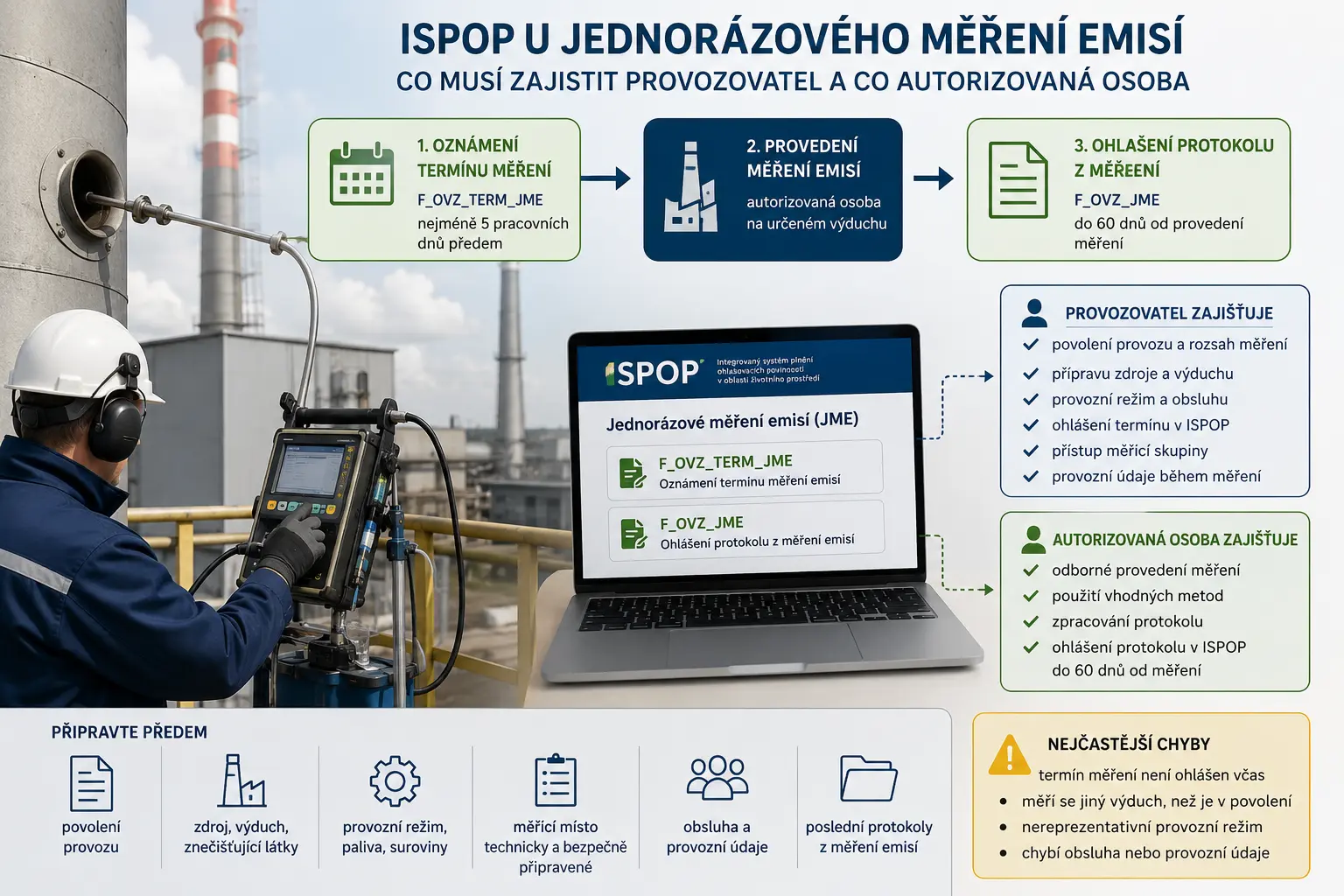
The basic division is simple. The operator is responsible for ensuring that measurement will take place, that the source will be ready, and that the measurement date will be duly notified. The authorised person is responsible for professional performance of the measurement, preparation of the report, and notification of the report in ISPOP.
| Who | What is typically ensured |
|---|---|
| operator | operating permit, ordering measurement, source preparation, operating regime, access to the measurement point, notification of the measurement date |
| authorised person | professional performance of measurement, measurement methods, sampling, evaluation, report, notification of the report in ISPOP |
| authorised representative | may perform ISPOP actions on behalf of the operator if correctly authorised in the Integrated Pollution Register |
In practice, the operator may agree with the measurement company that some ISPOP steps will be performed on their behalf as authorised representative. However, corresponding authorisation must exist. Without correctly set access, it cannot be assumed that notification will be carried out automatically.
Forms in ISPOP
For one-time emission measurement, two forms are particularly important:
- F_OVZ_TERM_JME – notification of the date of performance or cancellation of one-time emission measurement,
- F_OVZ_JME – notification of the one-time emission measurement report.
The date of one-time emission measurement must be notified at least 5 working days before measurement. If measurement lasts several days, the first day of measurement must meet this condition.
The authorised person subsequently notifies the report within 60 days of performance of the measurement.
What the operator must ensure before measurement
The operator should not address only the date of the site visit. Before measurement it is necessary to verify that it is clear what is to be measured, on which source, at which exhaust, and under what operating conditions.
Before ordering or notifying the date we recommend preparing:
- current operating permit,
- any amendments to the permit,
- operating rule, if prepared for the source,
- list of sources and exhausts,
- emission limits and pollutants to be measured,
- required measurement interval,
- information on fuel, raw materials or solvents,
- description of filtration, separation or waste gas treatment,
- data on normal operating regime,
- latest emission measurement reports,
- information on whether measurement concerns normal operation, a change, trial operation, or a requirement from an authority.
For operations with several exhausts it is necessary to clarify in advance whether each exhaust is to be measured, or whether the operating permit sets a different procedure. The Act proceeds from the principle that if a source pollutes through more than one chimney or exhaust, the level of pollution is determined at each of them unless the operating permit provides otherwise.
Notification of the measurement date
The measurement date must be notified in time. It is not enough to agree a date with the measurement team and assume that everything is thereby fulfilled. The operator must be sure that the date was actually notified in ISPOP using the correct form and within the correct deadline.
Before notifying the date it is appropriate to verify in particular:
- whether the facility is correctly registered,
- whether the operator's identification data are correctly stated,
- which source and exhaust the measurement concerns,
- whether the authorised person is correctly stated,
- whether a realistic date is chosen with regard to the operating regime,
- whether the source can be operated representatively on that date,
- whether safe access to the measurement point is ensured.
If an authorised representative is to notify the date, it is necessary to verify in advance whether they have correctly set authorisation in the Integrated Pollution Register precisely for this agenda. A general agreement by e-mail on its own is not enough.
Change or cancellation of the date
In practice, measurement may not be possible on the originally planned date. The reason may be a technology shutdown, breakdown, change in production plan, unprepared measurement point, safety problem, or unsuitable operating regime.
If the date is changed or cancelled for foreseeable reasons, this must be notified in the same way at least 1 working day before the originally planned date.
From a practical perspective it is important to distinguish:
- cancellation of the date,
- narrowing of the scope of measurement,
- extension of the scope of measurement,
- rescheduling to another date.
When the scope is extended or a new date is set, new notification may be necessary so that the deadline of at least 5 working days is met. It is therefore appropriate to prepare the scope of measurement well before the first notification.
What must be ready on the day of measurement
On the day of measurement the source must be operated so that the result corresponds to the purpose of the measurement. The operator should ensure in advance that the technology will be in operation, operating staff will be available, and the measurement team will have safe access to the exhaust.
What matters in particular:
- operate the source in a representative regime,
- have technology operating staff ready,
- allow access to measurement points,
- ensure safety of work at height or at the technology,
- document operating data during measurement,
- record consumption of fuel, raw materials or solvents,
- confirm the state of filtration or separation,
- record any deviations, breakdowns or non-standard regimes.
If the source does not run in the normal way on the day of measurement, it is better to address the situation in advance. Measurement carried out in a non-representative regime may be of little use to the authority or the operator.
What the authorised person ensures
The authorised person carries out emission measurement itself within the scope of their authorisation. They are responsible for use of appropriate methods, measurement equipment, sampling, evaluation and preparation of the report.
After measurement the authorised person notifies the report in ISPOP using form F_OVZ_JME. The deadline for notification of the report is 60 days from performance of the measurement.
After measurement the operator should check that they have received the report and that the data correspond to the measured source, exhaust, operating regime and purpose of the measurement. The report is subsequently used for operational records, consolidated operational records, any fees, checking compliance with emission limits, and communication with the authority.
Most common mistakes in practice
Similar mistakes often repeat in one-time emission measurement. Some arise even before the measurement team's site visit.
The most common problems are:
- the measurement date is not notified in time,
- the operator assumes that the measurement company will automatically carry out notification,
- authorisation in the Integrated Pollution Register is not correctly set,
- a different exhaust is measured than stated in the operating permit,
- the operating permit does not correspond to the actual state of the technology,
- it is unclear which pollutants are to be measured,
- the source does not run in a representative regime on the day of measurement,
- the measurement point is technically or safety-wise unsuitable,
- operating staff or operating data are missing during measurement,
- the report is subsequently not used correctly in operational records or consolidated operational records.
Good measurement begins before the measurement team's site visit. First the scope, source, exhaust, operating regime, permit and notification procedure must be clear.
Practical step-by-step procedure
Before one-time emission measurement we recommend proceeding as follows:
- Check the operating permit and required scope of measurement.
- Verify which sources, exhausts and pollutants are to be measured.
- Check whether the measurement point is technically and safety-wise prepared.
- Agree a date with the authorised person according to realistic operation of the source.
- Verify who will notify the date in ISPOP and whether they have authority to do so.
- Notify the measurement date at least 5 working days in advance.
- Prepare operating staff, operating data, fuels, raw materials and operational records.
- Operate the source representatively during measurement.
- After measurement, check the report and its link to the source, exhaust and permit.
- Use the results in operational records, consolidated operational records, fees or other documentation.
This procedure helps prevent a situation where measurement is technically correct but administratively or procedurally not fully usable.
What you can send us for assessment
Before measurement you can send us the operating permit, operating rule, latest emission measurement report, list of exhausts, description of the technology, data on fuel, raw materials or solvents, and information on the planned operating regime.
We will verify what scope of measurement follows from the documentation, which exhausts and substances need to be measured, whether the measurement point is technically prepared, and how to set the procedure correctly in ISPOP. For more complex operations it is appropriate to carry out this check before notifying the date, not only on the day of measurement.
Summary
For one-time emission measurement it is necessary to distinguish the technical and administrative parts. The operator ensures measurement, prepares the source and operating regime, and is responsible for notification of the date. The authorised person carries out measurement, prepares the report, and notifies the report in ISPOP.
For usability of the measurement it is important that the date was notified in time, measurement took place at the correct source and exhaust, the operating regime was representative, and the report subsequently links to operational records, consolidated operational records, fees and the operating permit.
Factual basis of the article
The article is based in particular on Act No. 201/2012 Coll., Decree No. 415/2012 Coll., ISPOP information, and the methodological communication of the Ministry of the Environment on notification of the date and report of one-time emission measurement.
| Source | Practical significance |
|---|---|
| Section 6 of Act No. 201/2012 Coll., on air protection | regulates determination of the level of pollution, one-time emission measurement, notification of the measurement date, and ensuring measurement by an authorised person |
| Section 32 of Act No. 201/2012 Coll. | provides that one-time emission measurement is carried out by an authorised person |
| Section 34 of Act No. 201/2012 Coll. | regulates obligations of authorised persons, including the measurement report and notification of data from the report |
| Decree No. 415/2012 Coll. | sets details on emission measurement, technical requirements and forms |
| ISPOP – forms F_OVZ_TERM_JME and F_OVZ_JME | practical information on forms for notification of the date and JME report |
| CENIA – ISPOP news on notification in 2026 | overview of new forms introduced in ISPOP in 2026 |
| MoE communication on JME notification | methodological interpretation of notification of the measurement date, cancellation or change of date, and notification of the report |
From a practical perspective, these sources show that one-time emission measurement must be correctly notified, professionally carried out, and subsequently documented by a report. The operator should have under control in particular notification of the date, preparation of the source, operating regime, and use of results in records. The authorised person is responsible for professional performance of measurement and notification of data from the report in ISPOP.
For operations with several exhausts, an older permit, an unclear measurement point, or a technology change we recommend checking the scope of measurement before notifying the date. This prevents a situation where measurement is carried out in the wrong scope or under conditions that will later not be sufficient for the given purpose.