
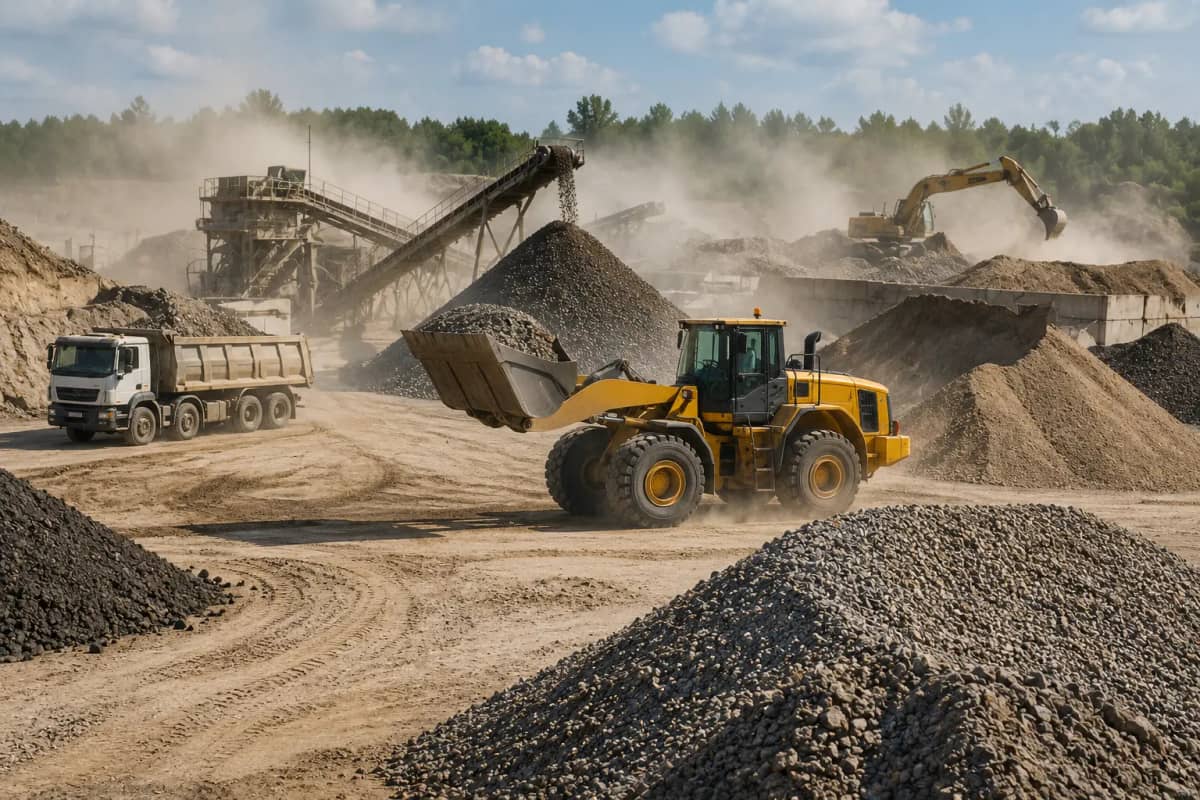
Why code 12.1 concerns operators, storage sites, and recycling areas
Dust from storage and handling of bulk materials used to be often underestimated in practice. An operator might have had an area in the site for soil, aggregate, recyclate, construction rubble, slag, coal, ash, wood chips, or other material, and it was not always clear whether this was merely a routine operational area or an air pollution source requiring a permit.
The new code 12.1 in Annex No. 2 to the Air Protection Act is aimed precisely at these situations. It does not address every pile of material in a site, but active handling of bulk materials, including their storage on open areas, where the prescribed capacity threshold is met.
This concerns operators especially at recycling centres, landfills and their associated areas, collection yards, soil storage sites, interim storage sites for construction waste, quarries, asphalt plants, concrete plants, construction companies, coal stores, aggregate stores, areas with construction rubble, or operations where dusty or bulk material is handled over the long term.
Basic rule: area of 3,000 m² or more
Code 12.1 applies to handling of bulk materials including their storage on open areas, where the activity is not listed elsewhere and the total designed deposit area is 3,000 m² or more. The Act simultaneously sets an exception for construction sites.
For a business, it is important to understand three terms correctly: bulk material, open area, and designed deposit area.
Bulk material does not have to mean only fine dust or sand. In practice it may also be crushed asphalt, construction rubble, aggregate, soil, ash, slag, wood chips, sawdust, or similar materials, if they are handled as a loose mass. What decides is not only grain size, but whether the material behaves as bulk material during handling and whether it can release dust during loading, transfer, tipping, pushing, or wind erosion.
An open area means an area exposed to the weather. If material is stored in a closed building, silo, bunker, hall, or covered space protected from wind and rain, assessment may be different. Conversely, a routine outdoor storage site, handling area, open area in a site, or an area protected only partially usually requires attention.
Designed deposit area is not the same as the current footprint of a single pile on the day of inspection. The area intended for storage and handling according to the project, operational layout, permitted use, or realistically defined operational capacity is assessed. If an operator has a storage site of 3,500 m², but on the day of inspection material is only on half the area, that does not automatically mean the area is assessed only according to the current pile.
Measuring the pile on the day of inspection is not enough
A common mistake in practice is to decide according to how much material is on the area today. Such an approach is risky. Code 12.1 works with the total designed deposit area, not only the immediate stock situation.
If the area is intended for various material piles to alternate during the year, with loading, transfer, movement, and seasonal storage, the purpose and capacity of the area are assessed. The immediate state may be important for photo documentation and understanding operation, but it must not replace assessment of the designed or operationally defined scope.
At older operations, a clear project drawing is often missing. In such a case it is advisable to proceed from a site plan, aerial image, operating rules, material movement records, decision on the facility, completion documentation, or the actual operational definition of the area. It is important to be able to justify how the area was determined.
When it is not code 12.1
Code 12.1 is a residual code for activities not listed elsewhere. That means it applies only if the given activity cannot be classified under another code in Annex No. 2 to the Air Protection Act.
This is very important for operators. If handling of bulk material is already part of another listed technology, for example a quarry, cement plant, foundry, landfill, concrete plant, or other permitted technology, it does not automatically have to be classified again under code 12.1. It is necessary to check whether this activity is included in the operating permit of the given source and whether it is sufficiently described in the operative part or binding conditions.
Typically, a waste landfill classified under code 2.2 will not, because of landfill operation itself, be classified again under code 12.1. A different situation may arise with an active soil storage site or other handling area that is related to landfill operation but is not part of the landfill as a source under code 2.2. If such an area exceeds the threshold and meets the characteristics of code 12.1, it may be addressed separately.
Similarly, caution is needed with quarries, recycling lines, concrete plants, or asphalt plants. Part of the activities may fall under their own technological code, while separate open storage sites or interim storage sites may require separate assessment.
Active storage site, or just an old pile?
Code 12.1 is aimed at active handling and storage areas. It is not enough that material has historically lain somewhere in the site. What decides is whether the area is intended and used for repeated or seasonal handling of bulk materials.
An active storage site may be, for example, an area where soil is repeatedly delivered, construction rubble is sorted or transferred, aggregate is stored, recyclate is loaded, material is moved with a wheel loader, or material is regularly taken for further use.
Conversely, an old unused spoil area, reclaimed area, permanent terrain adjustment, or an area with no realistic prospect of further handling may not be an active storage site within the meaning of code 12.1. It always depends on the specific operation and documentation. If material is actually moved, loaded, or reused, a claim that the area is inactive may not hold.
What is counted in the area
The area assessed includes the area intended for storage of bulk materials and handling of them. If there are several piles on one open area that are moved, supplemented, removed, or merged over time, this will usually be one active handling area.
Conversely, if there are genuinely separate areas that are not directly adjacent and are separated, for example, by buildings, terrain, or other operational division, they may not automatically be added together as one area. This question must, however, be assessed carefully. It is not enough formally to divide one large storage site into several parts if operationally they form one whole.
Parts where bulk materials are not handled are not counted in the area, for example areas for piece goods, containers, closed vessels, bagged materials, or building elements, if they are not handled as a loose mass. If, however, part of the same area is for piece material and part for bulk materials, it is advisable to separate these parts clearly in the drawing.
Why material type matters
The risk of dustiness is not the same for all materials. Moist soil behaves differently from dry recyclate, fine aggregate fraction, ash, slag, wood chips, sand, or construction rubble. For classification under code 12.1, what is key is whether it is bulk material and whether the area is open and actively used. For the dispersion study and operating conditions, however, the actual dustiness of the material is also important.
In practice, material fraction, moisture, proportion of fine particles, handling method, tipping height, frequency of loading, speed of vehicle movement, condition of paved areas, cleaning of roads, and dust suppression measures are monitored especially. For dry fine materials, wind erosion from the surface of the storage site may be decisive. For recyclate and aggregate, loading, transfers, sorting, crushing, or vehicle movement on dusty roads may be significant.
Therefore it is not appropriate to address only the question of whether the area has 3,000 m². It is equally important to know what is stored on the area and how the material is handled.
When an operating permit, dispersion study, and operating rules will be needed
If the area meets the characteristics of code 12.1 and exceeds a designed deposit area of 3,000 m², it is a listed stationary source. The operator must then address an operating permit under the Air Protection Act.
For code 12.1, the annex to the Act marks the obligation of a dispersion study and operating rules. A dispersion study assesses the contribution of the source to immission load, typically especially for PM10 and PM2.5 particles. Operating rules set technical and organisational measures to limit dustiness and rules for operation of the source.
In practice, an expert opinion by an authorised person may also be needed, especially when permitting a new source or when changing a permit, if this follows from the nature of the proceedings and statutory requirements. For existing operations, it is necessary to distinguish whether handling of material was already permitted as part of another listed source, or whether it is a newly addressed separate source.
The operator should therefore not start by ordering a dispersion study without prior classification of the source. The correct procedure is first to verify whether code 12.1 applies at all, whether the activity does not fall under another code, and whether or not it is included in an already issued operating permit.
What is addressed in a dispersion study
A dispersion study for handling of bulk materials is not prepared only according to area. It needs to describe the actual emission potential of the source. That means determining where and how dustiness arises.
For open storage sites, material handling, transfers, loading, unloading, vehicle movement, movement on site roads, and wind erosion from the surface of stored materials are usually assessed. Depending on the nature of operation, related technologies may also be important, for example sorting, crushing, screening, or material treatment. These may, however, have their own classification under another code.
The study should be based on realistic and defensible inputs: deposit area, material type, annual quantity, handling operations, operating hours, vehicle routes, material moisture, and proposed measures. If emission factors are used, their origin and appropriateness for the given type of operation must be clearly explained.
For dustiness, it is always important whether the gross theoretical state without measures is assessed, or the real state with measures such as wetting, misting, cleaning of roads, limiting tipping height, covering, windrows, paved areas, organisational restrictions in wind, or separation of fine fractions.
What operating rules should contain
Operating rules for code 12.1 should be a practical document according to which the source can actually be operated and controlled. They should not be only a formal annex to the application. For dusty areas, it is important to describe how dustiness will be limited in normal operation, in dry conditions, in wind, and in extraordinary situations.
Operating rules usually address especially definition of areas, types of stored materials, maximum deposit area, operating regime, equipment used for handling, vehicle routes, wetting, cleaning of roads, restrictions on handling in unfavourable conditions, keeping of operating records, and responsibilities of operators.
Well prepared operating rules must be consistent with what is stated in the application, dispersion study, and site plan. If the dispersion study counts on wetting and paved roads, these measures must also be reflected in operating conditions.
What documentation the operator should prepare
For initial assessment, a complete project is not necessary at once. Information from which it is possible to decide reasonably whether code 12.1 applies and what the scope of further documentation will be is needed.
Most important is a site plan or marking on an orthophoto map, where deposit areas, handling areas, vehicle routes, material inflows and outflows, and nearest residential development are defined. It is also necessary to describe material types, their fractions, annual quantity, maximum immediate quantity, operating hours, and handling equipment.
For quick orientation, this set of documentation helps:
| Documentation | Why it matters |
|---|---|
| Site plan or marking on a map | designed deposit area and relation to surroundings are determined |
| Deposit area in m² | decisive parameter for the 3,000 m² threshold |
| Material types and fractions | dustiness and suitable emission factors are determined |
| Annual material quantity | input for emission balance and operating regime |
| Description of handling | loading, unloading, transfers, pushing, sorting |
| Operating hours | important for dispersion study and permit |
| Vehicle routes | significant source of dust resuspension |
| Dust suppression measures | wetting, cleaning, covering, paving, operation restrictions |
| Existing operating permit | verifies whether activity is already permitted under another code |
If the operator does not have this documentation, it can often be prepared from a cadastral map, orthophoto map, operational description, waste records or material flows, and local survey.
Typical examples
A construction waste recycling centre has an open area where concrete and brick rubble, recyclate of various fractions, and soil are stored. If the total designed deposit area exceeds 3,000 m² and the area is not already permitted as part of another listed source, classification under code 12.1 must be verified.
A construction company has a long-term storage site for soil and aggregate in its site. It is not a construction site, but a permanent operational site. Material is delivered, removed, and transferred with a loader. If the area reaches the threshold, it may be a listed source.
A waste landfill has its own permit under code 2.2. Landfill operation itself is usually not assessed again as code 12.1. If, however, there is a separate active soil storage site beside the landfill that is not part of the landfill and serves another handling activity, separate assessment may be needed.
A quarry has permitted extraction, crushing, and sorting. The technology itself may fall under another code. Open areas for aggregate storage must, however, be checked according to whether they are already included in the permitted source, or whether they are a separate active storage site not listed elsewhere.
Most common operator mistakes
The most common mistake is to assess only the current material pile and not address the designed deposit area. A second common mistake is the assumption that if the material is not fine dust, it is not bulk material. For aggregate, recyclate, slag, or soil, dustiness can arise during handling and vehicle movement, especially in dry conditions.
Another mistake is not checking the link to other codes in Annex No. 2. The operator may then apply for a separate permit where the activity is already part of another permitted source, or conversely overlook a separate storage site that is not included in the existing permit at all.
An unclear site plan is also a problem. If it is not clear where exactly the storage site lies, what area it has, and where vehicles travel, a dispersion study or operating rules cannot be prepared reliably.
Practical procedure for operators
First, it is advisable to define all areas where bulk materials are stored or handled. A description of "storage site in the site" is not enough. Marking on a map, approximate area, and description of how the area is used are needed.
It is then necessary to determine whether it is an open area, whether it is an active storage site, and whether the total designed area reaches 3,000 m². At the same time, it must be verified whether the given activity is not already classified under another code in Annex No. 2 or included in an existing operating permit.
If classification under code 12.1 is confirmed, an application for operating permit and related documentation are prepared. For new or changed sources, this usually means a dispersion study, operating rules, and depending on the type of proceedings also an expert opinion. For existing sources, it is necessary to assess whether it is a new permit, change to an existing permit, or supplement to an already permitted source.
Outputs for the authority and for operation management
Well prepared documentation should give the authority a clear answer to several questions: what is the source of dustiness, what is its designed capacity, what materials are stored on the area, how they are handled, what is the impact on the immission situation, and what measures will be introduced to limit dustiness.
For the operator, such assessment also has practical significance. It enables rules to be set for wetting, cleaning, handling in wind, keeping records, and operational responsibility. This is important not only for the operating permit, but also for inspection by CEI, the regional authority, or handling of complaints about dustiness.
Factual basis of the article
The topic draws mainly on these legal and methodological sources:
- Act No. 201/2012 Coll., on Air Protection,
- Annex No. 2 to Act No. 201/2012 Coll., especially code 12.1,
- Act No. 42/2025 Coll., by which code 12.1 was added to the Air Protection Act,
- communication of the Air Protection Department of the Ministry of the Environment on application of code 12.1,
- methodological materials of the Ministry of the Environment on calculation of emissions from area sources and dustiness from storage and handling of materials,
- requirements for dispersion studies, expert opinions, operating rules, and operating permits under the Air Protection Act.
Useful links:
- Air protection news – Ministry of the Environment
- Act No. 201/2012 Coll., on Air Protection
- Act No. 42/2025 Coll.
Summary and next step
An area with bulk material can become a listed source under code 12.1 if it involves active handling or storage of bulk materials on an open area, the activity is not classified under another code, and the total designed deposit area reaches 3,000 m² or more. Construction sites are an exception.
The operator should not decide only according to the size of the current pile. It is important to define the designed deposit area, material type, operating regime, vehicle routes, related technologies, and existing operating permit.
Send us a site plan or marking on a map, deposit area, material types, annual quantity, description of handling, and existing operating permit. We will verify whether code 12.1 applies to your operation, whether it is a listed source, and what documentation will be needed for the regional authority – dispersion study, expert opinion, operating rules, or application for operating permit.