
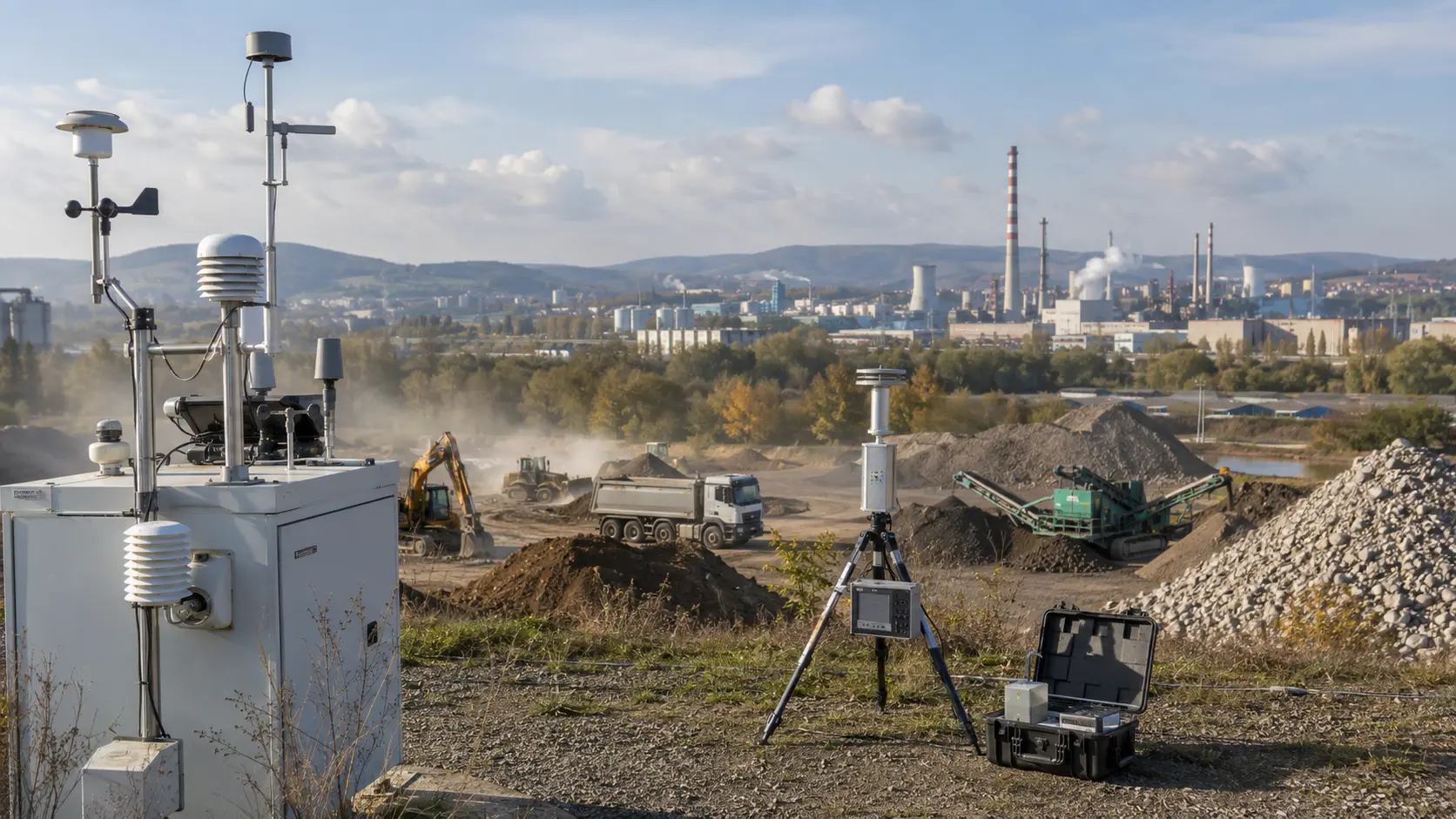
What is the ARAMIS project
ARAMIS is a large research project entitled Integrated System for Air Quality Research, Assessment and Control. It was created under the Environment for Life programme of the Technology Agency of the Czech Republic and brings together specialists from Ministry of the Environment agencies, universities, and the Czech Academy of Sciences.
The project focuses on developing and updating tools, methodologies, and procedures for assessing air quality, pollutant emissions, greenhouse gas emissions, emission projections, and impacts of pollution on health, ecosystems, energy, and other areas.
For a typical operator, ARAMIS may not look like a practical topic at first glance. For professional preparation of documentation for authorities, however, it matters. Project outputs may gradually influence emission factors, emission balances, dispersion studies, methodological arguments, dust assessment, and the quality of input data used in permitting processes.
Why ARAMIS matters for practice
In air protection, input data often decide the outcome. It is not enough to choose a calculation model or fill in an emissions table. What matters is what emissions are based on, which emission factor was used, whether it matches the specific technology, how source activity is documented, and whether inputs are defensible to the authority.
This applies especially to dispersion studies, expert opinions, operating permit changes, EIA, JES, summary operating records, air pollution charges, and operating records. If input emissions are weakly established, the entire follow-on professional documentation may be weak.
ARAMIS matters because it addresses refinement of emission factors, emission inventories, model inputs, and methodologies for areas that are often burdened with uncertainty in practice. These typically include fugitive emissions, construction dust, recycling lines, deposits, bulk materials, local heating, traffic, greenhouse gases, and some harder-to-quantify sources.
For the client, what matters is that quality professional documentation must stand on correct data. Outputs from projects such as ARAMIS help refine which data and emission factors are appropriate to use in specific situations.
Emission factors and emission calculation
One of the most practical benefits of ARAMIS is emission factors. These are used where emissions are not determined directly by measurement but by calculation from fuel quantity, raw materials, material, product output, operating time, or another reference variable.
Operators encounter emission factors when preparing summary operating records, charge returns, emission balances, dispersion studies, or expert opinions. For designers and investors, emission factors matter when designing new projects and assessing planned technology impact on the surroundings.
ARAMIS outputs are especially valuable where it was previously difficult to determine emissions accurately and uniformly. A good example is recycling lines for construction materials. The project states that measurements tracked different construction material mixes, including demolition mixes and mixes with natural aggregate, because material type affects the resulting emission factor.
In practice this means that when calculating emissions from a recycling line, an arbitrary general factor cannot be applied mechanically. It is necessary to address what material is processed, in what regime the line operates, whether dust suppression measures are used, and what purpose the calculation must serve.
Emissions from construction and construction dust
Another significant area is emissions from construction. Construction activity, demolition, earthworks, material movements, vehicle traffic, handling of bulk materials, and temporary deposits can be significant dust sources.
For investors, developers, municipalities, and designers this area matters mainly for larger buildings, demolitions, linear projects, recycling areas, earthworks, and projects near residential development. The authority or public may address not only operation after completion but also impacts during construction.
ARAMIS outputs on construction emissions can be useful for establishing TSP, PM10, and PM2.5 emissions from construction operations, designing dust suppression measures, and professionally justifying inputs for a dispersion study or EIA documentation.
For construction dust it is important to assess specific activities. Topsoil stripping, demolition, crushing, sorting, material storage, and vehicle movement on unpaved surfaces have different emission potential. Measures such as sprinkling, road cleaning, material covering, limiting drop heights, or traffic organisation are equally important.
Recycling lines, deposits, and bulk materials
Recycling lines for construction materials, deposits, and handling of bulk materials are operations where correct emission determination is often more complex than for a standard point exhaust. Emissions arise fugitively — from surfaces, transfers, crushing, sorting, handling, traffic, and material movement — not only from one stack.
This has a direct impact on dispersion studies, expert opinions, and operating permits. For these sources, technology, material flows, capacity, operating regime, deposit areas, handling, in-site traffic, and dust suppression measures must be carefully described.
ARAMIS outputs on recycling lines and source significance under Annex 2 to the Air Protection Act are important for this area. They can help professionally set emission inputs, defend factors used, and assess whether a specific activity is emission-significant.
Dispersion studies and input data quality
A dispersion study is sensitive to input emission quality. A model may be formally run correctly, but if input emissions are overestimated, underestimated, or poorly justified, the result will not be usable.
The ARAMIS project also addresses emission inventories, pollution source identification, modelling tools, and refinement of input data for air quality assessment. This matters for dispersion study practice as a whole. For more complex projects it is necessary to know whether emission factors, measurement results, emission limits, balance calculations, operating data, or a combination of inputs should be used.
For construction, recycling operations, aggregate, bulk material storage, energy, or industrial technologies, professional justification often decides. The authority should be able to see from the documentation why a specific emission factor was used, what activity was assigned to it, how measures were reflected, and whether the input matches real operation.
Greenhouse gases and emission balances
ARAMIS addresses not only classical pollutants but also greenhouse gases. This matters especially given growing importance of carbon footprint, GHG balances, ESG reporting, energy concepts, and assessing operation impacts on climate.
For a standard operating permit under the Air Protection Act, greenhouse gases are not always the main decision parameter. In broader environmental permitting their significance is growing. This applies to energy, industrial processes, agriculture, waste management, biogas plants, combustion processes, and projects where the investor must demonstrate climate impacts.
ARAMIS outputs on greenhouse gases can support more accurate emission balances, projections, and professional arguments where local immission impact and broader emission and climate context must both be assessed.
What this means for operators and designers
Operators and designers should understand ARAMIS outputs as a significant professional resource, not as a substitute for specific project assessment. Every operation has its own technology, capacity, material inputs, exhausts, operating regime, measures, and permitting history.
In practice it is appropriate to verify especially whether more current emission factors are available for the given source type, whether the calculation used matches actual technology, whether dust suppression measures are correctly reflected, and whether inputs are sufficiently justified for the permitting purpose.
| Situation | Why to follow ARAMIS outputs |
|---|---|
| dispersion study for recycling line or deposit | refinement of emission factors and better input defence |
| construction project with significant dust | bases for establishing emissions from construction operations |
| operating permit change | verification whether emission inputs and source classification are current |
| expert opinion | professional justification of emission significance and factors used |
| EIA or JES | higher-quality bases for air impact assessment |
| summary operating records or charges | check whether emission calculations use applicable inputs |
| GHG balance or climate assessment | link to greenhouse gases, projections, and emission factors |
Assessment outputs
When working with ARAMIS outputs we prepare a practical professional conclusion for the client usable in specific proceedings or documentation. The aim is to determine which methodological or data bases are relevant for the project and how to use them correctly.
The output may be, for example, professional justification of emission inputs for a dispersion study, emission calculation from construction activity, review of emission factors for a recycling line, dust suppression measure proposal, basis for operating permit change, emission balance for SPE or charges, or recommendation whether measurement, expert opinion, or further authority documentation is needed.
What you can send us for assessment
If you are preparing a project, dispersion study, operating permit change, EIA, JES, or emission balance and are unsure about input emissions, send us technology description, designed capacity, material inputs, operating regime, exhausts, deposit areas, handling description, proposed dust suppression measures, available emission measurements, and any authority requirement.
We will verify which emission factors or methodological bases are applicable for the case, whether ARAMIS outputs can be used, how to justify inputs for a dispersion study, and whether measurement, expert opinion, dispersion study, or other documentation must be added.
Summary
The ARAMIS project is important for air protection practice because it refines methodological and data bases for assessing emissions, air quality, dispersion modelling, and emission balances. For operators, designers, and investors, outputs on emission factors, construction dust, recycling lines, source significance, and greenhouse gases are most important.
Project outputs alone do not replace specific professional operation assessment. They are a valuable resource for better argumentation, more accurate calculations, and more defensible authority documentation. For more complex projects it pays to verify whether a more suitable emission factor, methodological procedure, or research output already exists that can refine emission calculation or a dispersion study.
Factual basis of the article
The article is based mainly on official ARAMIS project information, an overview of its results, and the legal framework for air protection in the Czech Republic.
| Basis | Practical significance |
|---|---|
| ARAMIS project – official website | basic project information, objectives, partners, funding, and focus |
| ARAMIS project results | overview of outputs on emission factors, construction dust, greenhouse gas emissions, modelling, and source identification |
| Emission factors for recycling lines of construction materials | practically significant output for calculating emissions from recycling lines |
| Act No. 201/2012 Coll., on air protection | basic legal framework for source permitting, emission balances, measurement, calculations, and operating obligations |
| Ministry of the Environment – air protection | methodological information and updates in air protection |
| Environment for Life programme – TA CR | applied research programme under which ARAMIS was supported |
When using ARAMIS outputs, their relationship to the specific project must always be verified. Source type, technology, capacity, material inputs, operating regime, available measurements, authority requirement, and documentation purpose decide. Emission factors are used differently for a dispersion study than for SPE, charges, expert opinion, EIA, or operating documentation.
ARAMIS outputs are especially valuable in professional practice where standard emission inputs are not sufficiently accurate or where more complex fugitive emissions, construction dust, recycling lines, deposits, bulk materials, greenhouse gases, or source emission significance are assessed.