
What is job categorisation
Job categorisation is the method by which jobs are classified according to the level of health risk. It does not assess only the job title, but actual working conditions: technology used, chemical substances, dust, noise, vibration, microclimate, organisation of work, duration of exposure, and effectiveness of protective measures.
In other words: it is not enough to write, for example, "production worker" or "line operator". For correct classification it is necessary to know what the worker actually does, how long they do it, and to which factors they are exposed while doing so.
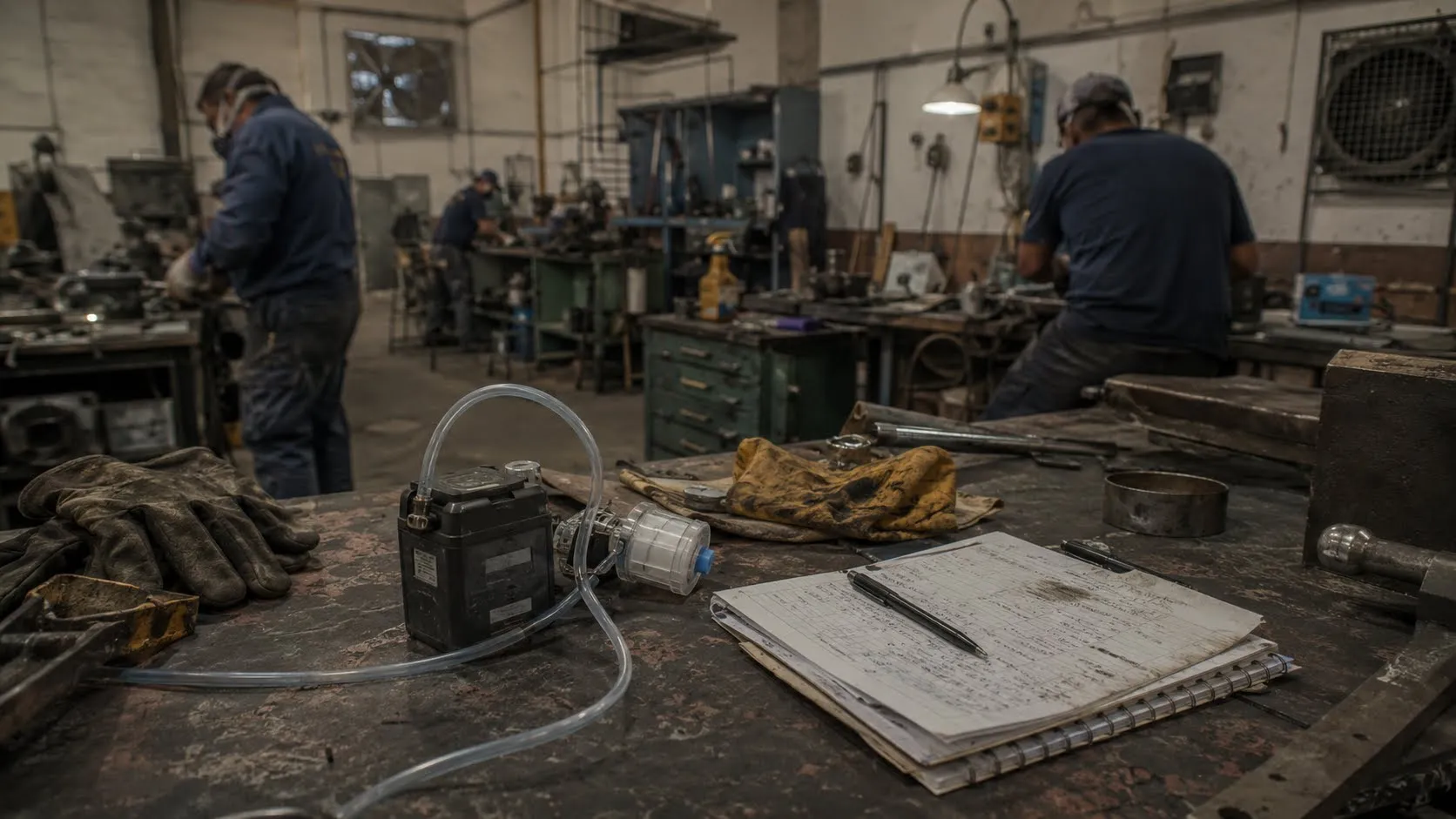
Job categorisation is addressed in practice especially at operations such as paint shops, welding shops, machining, foundries, recycling sites, boiler plants, waste facilities, chemical stores, dusty operations, noisy technologies, or workplaces with hand-held vibrating tools.
Job categories 1 to 4
Jobs are classified into four categories. The resulting category depends on which risk factors occur during work and how significant their level is.
| Category | Practical meaning | Typical situation |
|---|---|---|
| Category 1 | Work without presumed adverse effect on health | routine office work, insignificant exposure to risk factors |
| Category 2 | Risk factors are present but usually do not exceed hygiene limits | routine production with controlled exposure, lower noise, limited dust, work with chemical preparations under normal measures |
| Category 3 | A risk factor is significant, often above the limit or meeting criteria for risky work | above-limit noise, significant exposure to dust, chemical substances, or vibration |
| Category 4 | High risk to health | exceptionally burdensome work where risk cannot be sufficiently limited by normal measures |
The resulting job category is determined by the least favourably assessed factor. If, for example, a job position is in category 2 with regard to chemical substances but in category 3 with regard to noise, the final job classification cannot remain only in category 2.
This principle is also important when planning measurement. It is not enough to measure only one factor if several possible sources of burden actually occur in the operation.
When measurement must be documented
Measurement is documented when objective determination of the actual level of employee exposure is needed for job classification. For some factors, risk can be preliminarily estimated from technology, safety data sheets, technical data, or experience from similar operations. For many factors, however, measurement is the reliable supporting evidence.
Measurement is typically used as supporting evidence for categorisation for the following factors:
- chemical substances in workplace air,
- dust and dust fractions,
- workplace noise,
- hand-arm or whole-body vibration,
- microclimatic conditions,
- lighting, if relevant to working conditions,
- other factors depending on the nature of the work and requirements of the regional public health authority.
It is important that measurement takes place under representative operation. Measurement carried out during shutdown, reduced technology output, or outside typical work activity may not be usable for categorisation.
For job categorisation, it is essential that measurement reflects the employee's real exposure, not only the technical condition of equipment or the immediate situation on the day of the visit.
Category 2: why measurement is often needed
For category 2, it is sometimes wrongly assumed that measurement is not needed because it is not risky work. That conclusion is not correct. Although the employer usually classifies jobs into the second category independently, they must be able to substantiate the classification in substance.
If chemical substances are used in the workplace, dust is generated, noise is present, vibrating tools are used, or work is associated with heat or cold stress, a general statement alone is often insufficient.
Example from practice:
- An adhesive or solvent-based preparation is used in production.
- The safety data sheet lists volatile organic substances.
- Employees work with the preparation regularly.
- For job classification it is necessary to know whether concentrations in workplace air are well below the limit, close to the limit, or above the limit.
In such a situation, workplace air measurement is a suitable and often practically indispensable supporting document.
Chemical substances
For chemical substances, employee exposure to substances in workplace air is assessed. This may involve solvents, aldehydes, isocyanates, acids, bases, metals in welding fumes, or other substances according to the nature of the technology.
Measurement of chemical substances is often addressed at operations such as:
- paint shops and spray booths,
- bonding, sealing, and degreasing,
- welding shops and metal cutting,
- chemical surface treatment,
- plastics and rubber processing,
- laboratories and operations with chemical preparations,
- operations with curing, heating, or thermal decomposition of materials.
The choice of substances to measure should not be made by desk estimate. It is based mainly on safety data sheets, technology description, operating temperatures, application method, ventilation, duration of work, and the actual work procedure.
Practically important: a painter working directly in a spray booth faces different risk from a preparation worker, a dryer operator, or an employee who moves through the space only occasionally.
Dust
For dust, it is not enough to assess only that "there is dusting". What matters is the type of dust, its composition, particle size, and which fraction is significant from a health perspective.
In practice this may involve, for example:
- total dust,
- respirable dust fraction,
- dust containing crystalline silica,
- metal dust,
- wood dust,
- dust from building materials,
- welding fumes,
- dust from waste or bulk raw material processing.
Dust is often measured during grinding, cutting, crushing, sorting, transfer, handling of bulk substances, recycling of construction waste, wood processing, or production of building materials.
For dust it is advisable to consider before measurement whether only mass concentration should be assessed, or also dust composition. The same dust concentration can have completely different health significance depending on whether it is, for example, ordinary inert dust, dust containing respirable crystalline silica, or welding fume containing metals.
Noise
Noise is one of the most common factors in job categorisation. Employee exposure to noise during a work shift is assessed, usually in relation to an eight-hour shift.
Noise measurement is typically addressed at:
- presses,
- compressors,
- saws and grinders,
- machine tools,
- fans and ventilation,
- recycling lines,
- crushers and sorters,
- conveyors,
- hand-held pneumatic or electric tools.
In noise assessment, the time profile of work is essential. If an employee spends part of the shift at a noisy machine and part of the shift on another activity, this must be reflected in the assessment.
It is therefore not enough to measure "machine noise". For categorisation, exposure of the specific employee or representative work group is decisive.
Vibration
Vibration is assessed mainly for work with hand-held tools or at workplaces where vibration is transmitted to the whole body.
Typical examples:
- angle grinders,
- pneumatic hammers,
- demolition tools,
- vibrating plates,
- chainsaws,
- impact wrenches,
- forklift trucks,
- loaders,
- construction and handling equipment.
For vibration, the actual duration of tool or machine use is very important. The manufacturer's technical data may be an indicative supporting document, but may not correspond to the specific way of working, material used, tool wear, or actual work regime.
It is therefore advisable to combine technical data, time profile of work, and, where necessary, direct vibration measurement.
How representative work activities are selected
A representative work activity is an activity or shift that corresponds to the usual actual burden on employees. It should not be an artificially extreme situation that occurs exceptionally, nor a quiet day when the main risky work is not performed at all.
When selecting a representative activity, the following are assessed in particular:
- what activities the worker actually performs,
- how long individual activities last,
- when the highest exposure occurs,
- whether work differs between shifts,
- whether employees rotate between several workplaces,
- whether work changes according to season or orders,
- whether there are differences between normal operation, maintenance, cleaning, and extraordinary operations.
Example: welding shop
In a welding shop, not all employees have the same exposure. A manual welder will be assessed differently from an operator of a robotic welding station, a worker grinding welds, and an inspector who moves on the workplace only part of the shift.
If all these activities were grouped under one general position "welder", the categorisation result could be inaccurate.
Example: paint shop
In a paint shop there may be a difference between the painter, preparation worker, drying technology operator, paint mixing worker, and dispatch employee. Each of these activities may have different exposure to chemical substances, different time spent in the risk area, and different effect of ventilation.
Well-prepared measurement therefore starts with a description of operation and work activities, not merely with an order to "measure chemicals".
What to prepare before measurement
Before measurement it is advisable to gather basic supporting materials. This speeds up preparation, refines the choice of factors to measure, and reduces the risk that an important factor will be overlooked.
Recommended supporting materials:
- list of job positions and work activities,
- description of technology and operating regime,
- safety data sheets of substances and mixtures used,
- data on working hours and duration of exposure,
- information on ventilation and extraction,
- information on personal protective equipment used,
- existing job categorisation, if any,
- requirement from the regional public health authority, if issued.
This information makes it possible to design measurement so that it matches the actual needs of the operation and the requirements of the public health authority.
Most common mistakes in job categorisation
Job categorisation is problematic especially when it is prepared too generally. A formal document without link to actual operation may not withstand inspection.
Common mistakes include, for example:
- adopting old categorisation after a technology change,
- missing measurement for factors that cannot be reliably estimated,
- measurement outside normal operation,
- incomplete selection of chemical substances according to safety data sheets,
- noise assessment without a time profile of work,
- underestimation of dust during grinding, cutting, or handling of bulk materials,
- failure to distinguish different work activities within one operation,
- incorrect use of measurement results for another job position.
Correct categorisation should reflect the current state of operation. If technology, raw materials, ventilation, organisation of work, or production scope changes, it is advisable to verify whether the original classification still applies.
Summary
Job categorisation is not just an administrative obligation. It is an expert assessment of working conditions that has a direct impact on employee health protection, occupational health services, communication with the regional public health authority, and setting technical and organisational measures.
Measurement is needed especially where chemical substances, dust, noise, vibration, or other measurable factors occur for which the level of risk cannot be reliably determined by estimate alone. For measurement to be meaningful, it must correspond to representative work activity and actual employee exposure.
Send us a requirement from the regional public health authority, existing job categorisation, safety data sheets, operation description, or list of work activities. We will propose a suitable scope of measurement as supporting evidence for correct job classification and further steps with the hygiene station.
Factual basis of the article
The article is based mainly on the following regulations:
- Act No. 258/2000 Coll., on public health protection,
- Decree No. 432/2003 Coll., on job categorisation,
- Government Regulation No. 361/2007 Coll., on health protection at work,
- Government Regulation No. 272/2011 Coll., on protection of health from adverse effects of noise and vibration.
The practical parts of the article draw on common practice in workplace environment measurement, especially in assessing chemical substances, dust, noise, and vibration for job categorisation and communication with the regional public health authority.