
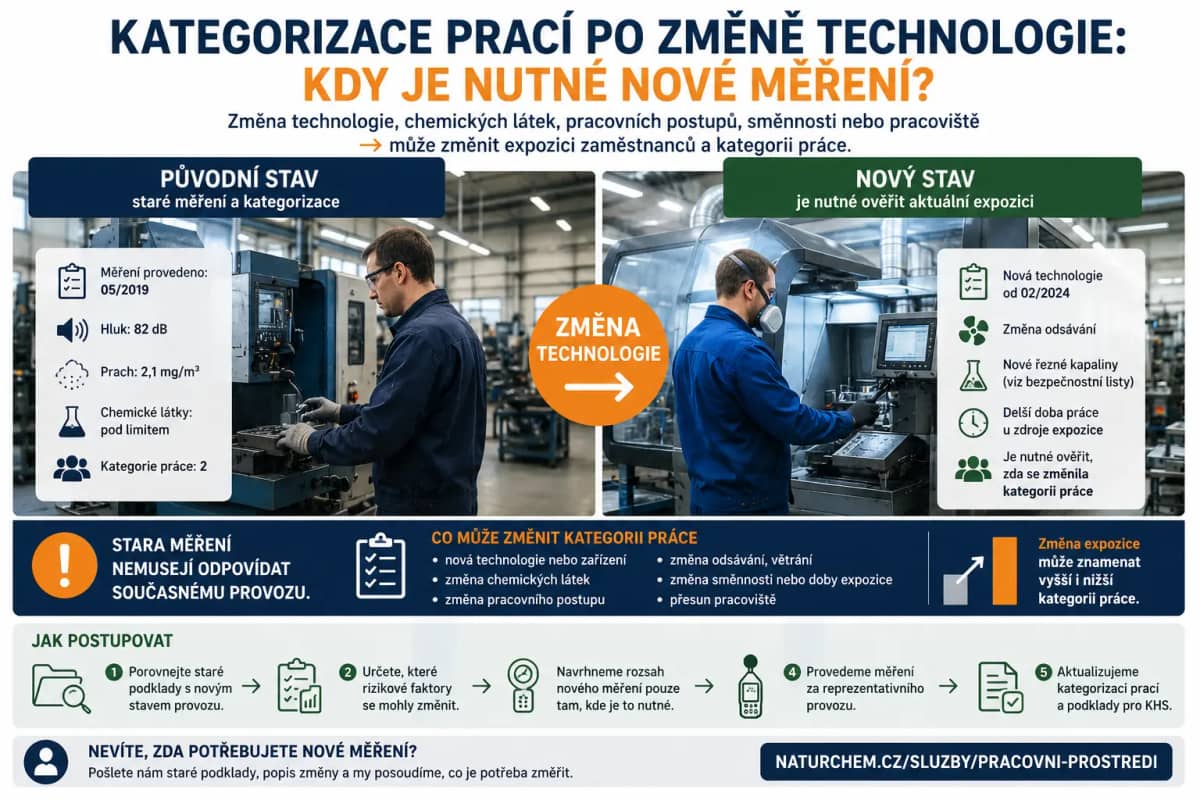
Why old categorisation may not suffice after operation change
Many companies have job categorisation prepared years ago and consider it a closed matter. That is understandable, but from the perspective of work environment it is risky. Job categorisation is not a one-off administrative document without link to actual operation. It is based on specific working conditions, technologies, substances used, exposure duration and organisation of the shift.
If these conditions change, the level of health risk may also change. After a technology change, an employee may be exposed to higher noise, a different chemical substance, more dust, a different microclimate or a longer time working under load. Conversely, new technology may reduce exposure, for example through better extraction, enclosure or automation.
What matters is that the company must be able to demonstrate that job classification corresponds to the current state. If the company has a measurement report describing old technology, different substances or a different work regime, it may not be sufficient during a KHS inspection.
What is considered a significant change
A significant change does not have to mean only a major investment in a new production line. In practice, smaller changes are often important too if they affect employee exposure.
A typical example is a paint shop switching to a different coating system. From the production perspective it may be only a change of paint or hardener supplier. From the work environment perspective, however, the composition of volatile organic substances, isocyanate content, application method and level of worker exposure may change.
Similarly in a welding shop, the number of welding sources may not be the only decisive factor. What matters is what is welded, by what method, for how long, in what space and with what extraction. A switch to a different material, increase in welding volume or change of ventilation may mean that old welding fume measurement is no longer representative.
In warehouses and handling operations, change may mean a new operating regime, longer work with forklift trucks, worse travel routes, night shifts or relocation of the workplace to another hall. In machining, grinding and cutting, a new machine, different tools, different working fluid or change of extraction may be decisive.
In simplified terms: if what affects noise, dust, chemical substances, vibration, microclimate, physical load or another work environment factor has changed, it is necessary to verify whether old supporting materials are still usable.
When new measurement usually makes sense
New measurement is appropriate especially when the change affects employee exposure itself. It is not enough to ask whether a new machine was purchased. The right question is: has what the worker is exposed to during a shift changed?
New measurement or expert assessment is usually appropriate when installing new technology, expanding production, introducing a new chemical substance, changing extraction, relocating the workplace, changing shift pattern or extending time spent working at a risk source. It is equally appropriate to respond to a KHS requirement, occupational health services, internal audit or a situation where original reports do not describe the current state.
Operations with chemical substances deserve special attention. In painting, bonding, degreasing, cleaning, printing, lamination or work with resins, even a seemingly minor change of preparation can mean a different hygienically significant factor. Current safety data sheets and real substance consumption are therefore important at these operations.
When it is not necessary to measure everything again
Technology change does not automatically mean that complete workplace environment measurement must be repeated. The correct procedure is first to compare the old and new state. Sometimes it turns out that only one factor has changed while others remained unchanged.
For example, with a new spray booth it may be necessary to address chemical substances and air flow, but vibration may not need to be reassessed. With a new grinder, noise and dust may be important while chemical substances do not change. With relocation of an office in a production site, microclimate or lighting may be decisive, not automatically all work environment factors.
The aim is therefore not to measure as much as possible. The aim is to have current, substantively correct and defensible supporting materials for those factors that may have changed and that are truly important for job categorisation.
How to proceed in practice
First it is advisable to take the original job categorisation decision or notification and see what measurements it was based on. It is important to find out which job positions were assessed, which activities were measured, what the shift length was, what substances were used and under what operation the measurement took place.
Then the new state must be described. Not generally as "technology replacement", but specifically: what changed, where, from when, for which workers, how often the activity is performed and how long it lasts during a shift.
Only then does it make sense to propose the scope of measurement. For one company it may be only supplementary noise measurement. For another, chemical substances in workplace air, dust, microclimate and noise. For another company the conclusion may be that old measurement is still usable because the change does not affect worker exposure.
What the company should prepare
For a quick assessment, it is usually sufficient to prepare several basic supporting materials. Most important are old measurement reports, existing job categorisation, description of the technology change and current operation information.
For chemical substances, safety data sheets and approximate consumption are essential. For noise, dust and vibration, it is important to know how long the worker actually works at the source. For microclimate and ventilation, workplace layout, heat sources, air flow and nature of work are important.
Practically, the following minimum set of data helps in particular:
| Supporting material | Why it is important |
|---|---|
| Old job categorisation | shows how jobs have been classified so far |
| Old measurement reports | allow assessment of whether they are still usable |
| Description of technology change | determines which factors may have changed |
| Safety data sheets | essential for chemical substances and mixtures |
| Exposure times during shift | decide actual worker load |
| Shift pattern and work organisation | affect characteristic shift |
| KHS requirement | helps set the correct scope of documentation |
Examples from practice
In a manufacturing company, an old welding shop with two workstations was originally measured. After several years, additional welding booths were added, extraction changed and production volume increased. In such a case, original measurement may no longer suffice, even though it is still welding. The scope of work, number of sources and operating conditions changed.
In a paint shop the company replaced the original coating system with another. At first glance the technology remained the same, but the mixtures used changed. For job categorisation it is then necessary to verify whether exposure to solvents, isocyanates or other hazardous substances has changed.
In a warehouse, forklift trucks began to be used for a longer part of the shift and part of the routes run on uneven outdoor surfaces. Original noise or whole-body vibration assessment may not correspond to the new work regime. What matters is not only the type of truck, but also driving time, surface, speed and shift organisation.
In a machining shop a new machine with better enclosure and extraction was installed. In such a case, new measurement may conversely document reduced exposure and confirm that the job remains in the existing category, or that some conclusions can be updated more favourably.
What is at risk if the change is not addressed
The greatest risk is not finding that new measurement is needed. The bigger problem is documentation that does not correspond to reality. During a KHS inspection it may then be difficult to demonstrate why the company still relies on old reports when operation already looks different.
Outdated categorisation can also affect occupational health services, protective equipment, preventive measures, informing employees and internal risk management. If an employee works in a different exposure than the company states in documentation, unnecessary legal and operational risk arises.
For company management it is therefore advantageous to evaluate the change in time. It does not always have to mean extensive measurement. Often it is enough to review old supporting materials expertly, identify differences and measure only those factors that may actually have changed.
How expert assessment helps
Expert assessment should help the company mainly in deciding what is actually needed. It is not about automatically proposing the widest possible measurement, but setting an appropriate scope according to operation, risk factors and KHS requirements.
A useful procedure is to compare old reports with the new state, determine which data are still usable, which are outdated and which are missing. Only then is noise, dust, chemical substances, vibration, microclimate, lighting or other factors measurement proposed.
Well-prepared measurement should take place under representative operation. If measurement is carried out on an exceptionally quiet day, with technology shut down or during reduced production, the result may not be suitable for job categorisation.
Output for KHS and internal documentation
The output may be a workplace environment measurement report, expert evaluation of the change, proposal for updating job categorisation or supporting material for communication with KHS. It should always be clear which job was assessed, what change occurred, which factors were verified and whether current job classification corresponds to the new state.
For the company it is practical to have documentation arranged so that it is evident why some factors were measured again and why others did not need to be repeated. Such an approach is usually more defensible than formal repetition of all measurements without link to actual operation change.
Factual basis of the article
The topic is based mainly on the following legal and methodological sources:
- Act No. 258/2000 Coll., on public health protection,
- Decree No. 432/2003 Coll., setting conditions for classification of jobs into categories,
- Government Regulation No. 361/2007 Coll., setting conditions for health protection at work,
- Government Regulation No. 272/2011 Coll., on protection of health from adverse effects of noise and vibration,
- methodological information of the Ministry of Health and National Institute of Public Health on job categorisation.
Useful links:
- Work environment – NATURCHEM
- Job categorisation – Ministry of Health
- Job categorisation – National Institute of Public Health
- Act No. 258/2000 Coll.
- Decree No. 432/2003 Coll.
- Government Regulation No. 361/2007 Coll.
Summary and next step
After technology, workplace, shift pattern, chemical substance or work procedure change, it is advisable to verify whether existing job categorisation still corresponds to actual operation. That does not automatically mean repeating all measurements. It means expertly comparing old supporting materials with the new state and supplementing only those measurements that are truly important for current employee exposure.
Send us old reports, job categorisation decisions or notifications, description of the technology change, safety data sheets and basic information on shift pattern. We will compare old supporting materials with the new operation and propose an appropriate scope of workplace environment measurement for updating job categorisation.