
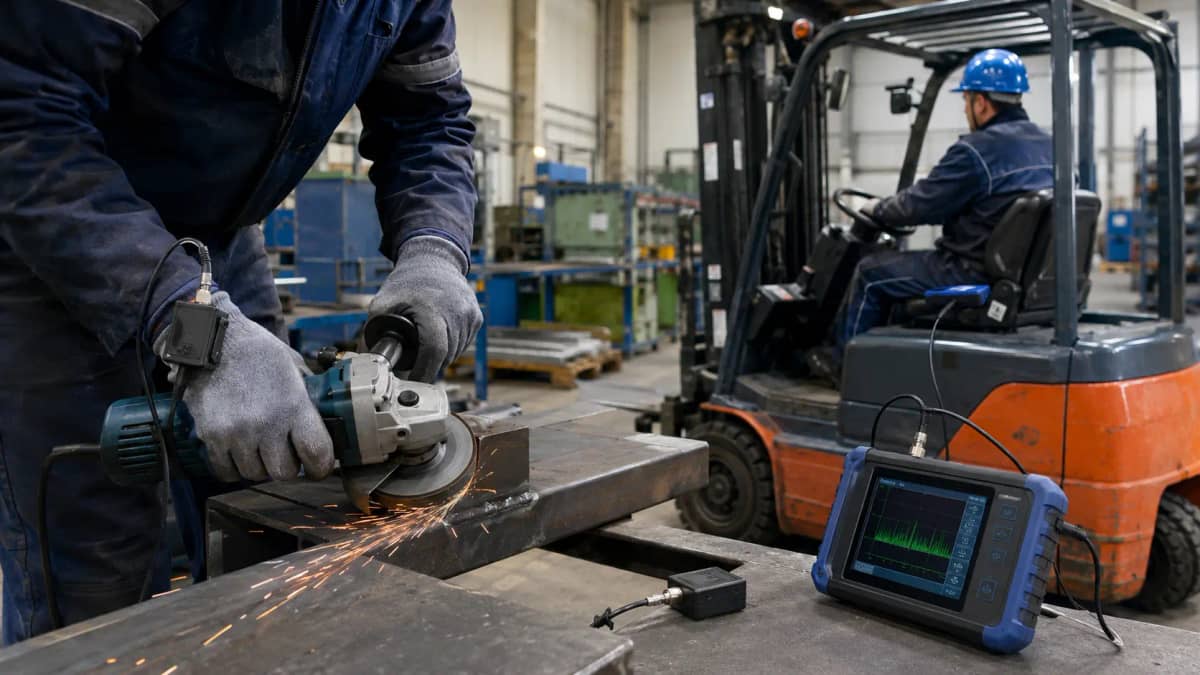
Why it is not enough to say there is vibration at the workplace
In work environment assessment we often encounter situations where the operator knows that vibrating tools or machines are used, but is not sure what type of measurement is actually needed. In practice this is not a minor detail. For measurement, exposure calculation and subsequent job classification it is essential whether vibration is transmitted to the hands or acts on the whole body of the employee.
Typical vibration sources occur in manufacturing, construction, maintenance, repair shops, agriculture, transport within sites, warehouses or when operating construction and handling equipment. Examples include grinders, drills, demolition hammers, rammers, compacting equipment, chainsaws, hand pneumatic tools, forklift trucks, loaders, tractors or other self-propelled machines.
For the employer it is important to know that data from the manufacturer or machine technical sheet may be a useful guide, but for job categorisation purposes they are usually not sufficient. What matters is the real way the machine is used, work procedure, tool condition, material, exposure duration and organisation of the shift.
Hand-arm vibration
Hand-arm vibration is addressed when the worker holds a tool or workpiece in the hand through which vibration is transmitted to the hands and arms. It typically concerns work with hand-held electric, pneumatic, hydraulic or motor tools.
Examples of activities:
- grinding, cutting, drilling, sawing, demolition, riveting, tightening and surface machining,
- work with angle grinder, drill, pneumatic hammer, impact wrench, chainsaw or brush cutter,
- holding a vibrating workpiece during machining if vibration is transmitted through the worker's hands.
For this type of exposure, the total value of vibration acting on the hands is assessed. In simplified terms, it is not measured only whether the tool vibrates, but how large the resulting employee exposure is during actual working time during a shift.
It is important to correctly determine how long the worker actually works with a specific tool. Having a grinder available for the whole shift is not the same as actually grinding for, for example, 45 minutes of net time. Exposure time has a fundamental effect on the result.
Whole-body vibration
Whole-body vibration, sometimes also referred to as vibration transmitted to the whole body, is addressed when vibration acts on the employee through the seat, floor, platform or another point of body contact with the machine or workplace.
Typical examples are:
| Work situation | Typical exposure |
|---|---|
| Forklift truck driver | vibration transmitted through the seat |
| Loader, tractor or construction machine operator | whole-body vibration and shocks during driving |
| Work on vibrating platform or at machine with vibration transfer to floor | whole-body vibration through feet |
| Driving on uneven site surface | increased whole-body vibration according to road condition |
For whole-body vibration, the condition of travel surfaces, seat quality, technical condition of the machine, driving speed, tyre type, truck load and work organisation are often very important. For a forklift truck, the difference between a smooth industrial floor and broken outdoor surface can be fundamental.
Hands or whole body? Practical distinction
The basic question is: through what path is vibration transmitted to the worker.
| Question | Probable type of measurement |
|---|---|
| Does the worker hold vibrating tool in the hand? | hand-arm vibration |
| Does the worker hold vibrating workpiece? | hand-arm vibration |
| Does the worker sit on machine, truck or vehicle? | whole-body vibration |
| Does the worker stand on vibrating platform or floor? | whole-body vibration |
| Does the worker combine hand tools and machine operation? | both types of assessment may be needed |
In some operations both types of exposure are combined. For example, a maintenance worker may spend part of the shift operating handling equipment and part of the shift using a hand grinder or percussion drill. In such a case vibration cannot be assessed with one general conclusion. Work activities must be divided, exposure types determined and assessed separately.
What vibration measurement determines
Vibration measurement is not just placing a sensor on the machine. For the result to correspond to actual work and be usable for categorisation, the characteristic shift must be correctly described.
For hand-arm vibration, the specific tool, way it is held, work regime and net exposure time are usually monitored. For whole-body vibration, vibration transfer to the body is measured, typically at the point of employee contact with the machine or workplace, for example on the driver's seat.
The output of measurement is a report stating in particular:
- identification of workplace, work activities and vibration sources,
- description of measured work operations and actual exposure time,
- measured vibration values and conversion to relevant exposure time,
- assessment of results in relation to hygienic limits and needs of job categorisation.
Measurement result is not assessed in isolation. It must always be related to a specific job, specific employee or group of employees, characteristic shift and actual work organisation.
Vibration and job categorisation
Job categorisation serves to assess health risks at work. For vibration, job classification depends on the level of exposure and whether it concerns hand-arm vibration or whole-body vibration.
In simplified terms, work with low exposure may fall into category 1 or 2, while upon reaching or exceeding permissible exposure limits it may be category 3 work, or at higher exposures category 4. The specific conclusion must always be based on measurement, exposure calculation and applicable categorisation criteria.
Overview of the principle:
| Type of exposure | What is assessed | Typical significance for categorisation |
|---|---|---|
| Hand-arm vibration | exposure of hands and arms when working with tools or vibrating workpiece | often manufacturing, maintenance, construction, repairs |
| Whole-body vibration | body exposure through seat, floor or platform | often forklift trucks, construction machines, tractors, loaders |
| Combined exposure | different activities within a shift | work operations must be divided and assessed separately |
For the employer it is important that job categorisation is not just a formal table. It is supporting material for communication with KHS, occupational health services, setting preventive measures, work organisation and possibly also for addressing risky work.
What supporting materials to prepare before measurement
To design vibration measurement correctly, basic operation information should be prepared. The more precise the supporting materials available in advance, the better representative measured operations can be chosen and unnecessary repetition of measurement avoided.
Before measurement we recommend preparing:
| Supporting material | Why it is important |
|---|---|
| List of tools and machines used | possible vibration sources are identified |
| Types and serial numbers of equipment | helps unambiguous identification of sources |
| Description of work procedures | distinguishes real operations and work regimes |
| Net working times with tool or machine | decisive for exposure calculation |
| Shift pattern and shift length | affects conversion to characteristic shift |
| Number of employees in the job | data needed for categorisation |
| Information on alternation of activities | allows correct assessment of variable exposure |
| Condition of surfaces, floors and seats on equipment | significant mainly for whole-body vibration |
For hand tools it is advisable to state not only the tool name but also typical activity. The same grinder may have different exposure during light edge deburring and during intensive grinding of larger welds. For forklift trucks it is important whether driving is only on a level hall floor or also on outdoor areas, over thresholds, joints and unevenness.
Common mistakes in vibration assessment
In practice some mistakes recur that can lead to incorrect results or unnecessary complications in communication with KHS.
One of the most common mistakes is confusing both types of vibration. The operator may, for example, address a forklift truck as hand vibration because the worker holds the steering wheel. In reality, however, for a forklift truck driver it will usually mainly concern whole-body vibration transmitted through the seat. Conversely, for a hand grinder, drill or demolition hammer, hand-arm vibration is typically addressed.
Another common mistake is using a rough estimate of exposure time. If it is automatically assumed that the employee works with vibrating tools for a full 8 hours, the result may be significantly overestimated. Conversely, an overly optimistic estimate may underestimate real risk. The report must be based on a realistic characteristic shift.
Measurement under non-representative conditions is also a problem. If exceptionally quiet operation, a new tool, smooth route or a different work procedure than employees normally perform is measured, the result may not correspond to actual exposure.
What can be done to reduce vibration exposure
Vibration measurement should not be only fulfilment of a requirement for categorisation. Its practical significance lies mainly in showing where decisive exposure arises and how it can be reduced.
For hand-arm vibration, selection of more suitable tools, regular maintenance, sharp and correct working tools, limiting work with the worst sources, alternation of activities and reasonable shift organisation can help. It is also important not to underestimate work in cold, because cold can worsen the effects of vibration on the hands.
For whole-body vibration, improvement of travel surfaces, maintenance of trucks and machines, quality seat, correct seat adjustment according to driver weight, speed limitation on uneven surfaces and appropriate route planning are often effective. For handling equipment, floor condition often has greater practical significance than the type of truck itself.
When to order vibration measurement
Vibration measurement is advisable to address especially when:
| Situation | Why to address measurement |
|---|---|
| You use vibrating hand tools | there may be hand-arm vibration exposure |
| Employees operate forklift trucks or machines | there may be whole-body vibration |
| KHS requires supporting materials for categorisation | measurement is supporting evidence for job classification |
| Technology or work procedure is changing | original categorisation may no longer correspond |
| You are introducing new machines or tools | it is advisable to verify actual exposure |
| You are addressing health problems or occupational health remarks | measurement helps objectify work risk |
For new or changing operations it is advisable to address vibration together with other work environment factors, for example noise, dust, chemical substances, microclimate, physical load or working posture. Job categorisation is usually not assessed according to one isolated factor, but according to the set of risk factors of the given job.
Measurement outputs
The output is a vibration measurement report that can serve as expert supporting material for job categorisation, communication with KHS and setting measures to protect employee health. Part of the assessment is not only the measured value itself, but also description of work operations, exposure time and expert evaluation of results.
A well-prepared report should be understandable not only for an OHS specialist, but also for company management, HR, occupational health service and the public health protection authority. It should clearly state what was measured, under what conditions, how exposure time was determined and what significance the results have for job categorisation.
Factual basis of the article
The topic of vibration measurement at work is based mainly on the following legal and expert sources:
- Act No. 258/2000 Coll., on public health protection, especially provisions on job categorisation,
- Decree No. 432/2003 Coll., setting conditions for classification of jobs into categories,
- Government Regulation No. 272/2011 Coll., on protection of health from adverse effects of noise and vibration,
- methodological and information materials of the National Institute of Public Health on job categorisation,
- Czech technical standards used for vibration measurement and assessment.
Summary
For vibration in the workplace it is first necessary to correctly distinguish whether it concerns hand-arm vibration or whole-body vibration acting on the body. A hand grinder, drill or demolition hammer means a different type of exposure than a forklift truck, loader or construction machine. For job categorisation, not only the vibration source itself is decisive, but also actual working time, work procedure and characteristic shift.
If you are not sure whether to address vibration from hand tools, forklift truck vibration, whole-body vibration or a combination of several activities, send us a list of machines, tools, work procedures and approximate working times. We will propose a suitable scope of vibration measurement for work environment and job categorisation.